
Manual Handling Course
Quantity: 1

Duration 3 hours
100% online training
Start when you like
Learn on any device (desktop, mobile or tablet)
Instant assessment and result
1 learner per course
Train teams of all sizes
Bulk discounts starting at 10% off 10 courses
Pay by invoice with 30 day payment terms available (5+ courses)
Includes a 10% discount for 10+ courses
This online Manual Handling Training shows learners the dangers of lifting and handling improperly. Through videos, diagrams, and downloadable resources, the course provides the practical techniques needed to lift safely and the steps that can be taken to mitigate risks in the first place.
It follows the requirements of the Manual Handling Operations Regulations 1992 (MHOR) and is assured by City & Guilds and other independent accreditation bodies.
100% online training
Access anywhere
Same day digital certificate
Printed certificate posted next working day
Full audio voiceover
Assessment retakes at no extra cost
Learn at your own pace with no completion deadlines
Written in compliance with the Manual Handling Operations Regulations 1992 (MHOR)
Developed by qualified health and safety professionals
City & Guilds Assured
Accredited by CPD and approved by IIRSM
Downloadable module recaps of key learning points
Bulk discount for orders of 10+ courses
Save on our courses when you buy more training upfront. Lock in a better price now and access the training whenever you need to. You can mix and match any of our courses too and get the discount off your whole order.
10+ courses = 10% off
50+ courses = 20% off
100+ courses = 30% off
500+ courses = 40% off
Upon completion of this course, you will be able to:

City & Guilds Assured
Thoroughly reviewed independently by City & Guilds learning and development experts, this course is approved as City & Guilds Assured. High Speed Training is the first e-learning provider to have online courses awarded City & Guilds Assured status.
Accredited by CPD
All of our courses are accredited by the CPD Certification Service as conforming to universally accepted Continuing Professional Development (CPD) guidelines.
Assured by RoSPA Qualifications
This course is also assured by the Royal Society for the Prevention of Accidents through their RoSPA Qualifications Assurance System, as providing up-to-date, quality and content-approved training.
Approved by IIRSM
Additionally, this course has been independently recognised by the International Institute of Risk and Safety Management as meeting the standards of its Training Approval Scheme.
Recommended renewal:
1 year
What does this mean? This certificate does not have an expiry date, however, based on industry best practice guidelines there is a recommended renewal period.
Our in-house Learning Designers develop all of our courses to give you and your learners the most engaging training possible.
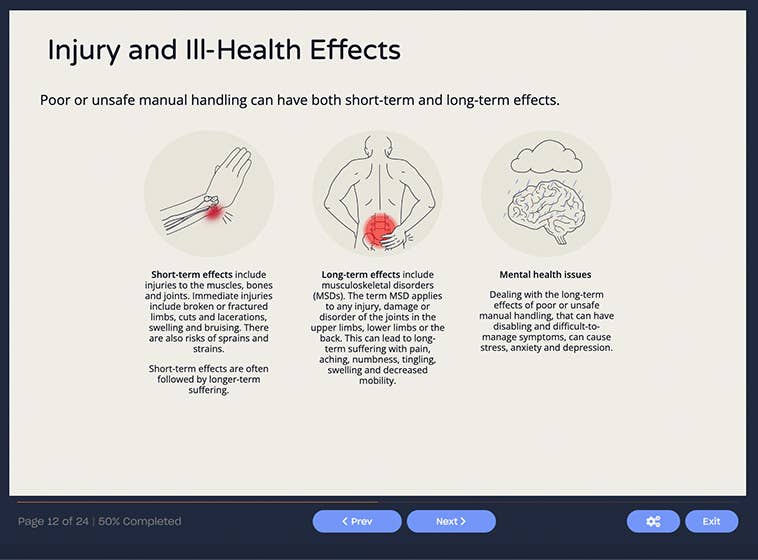
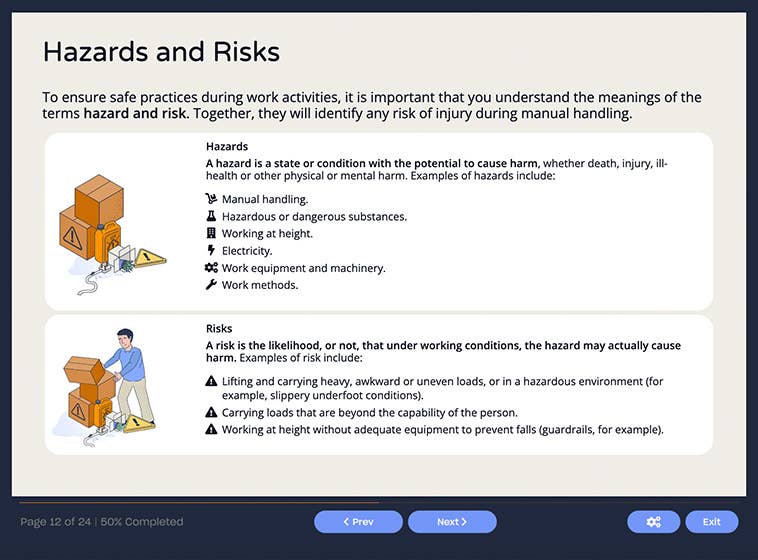
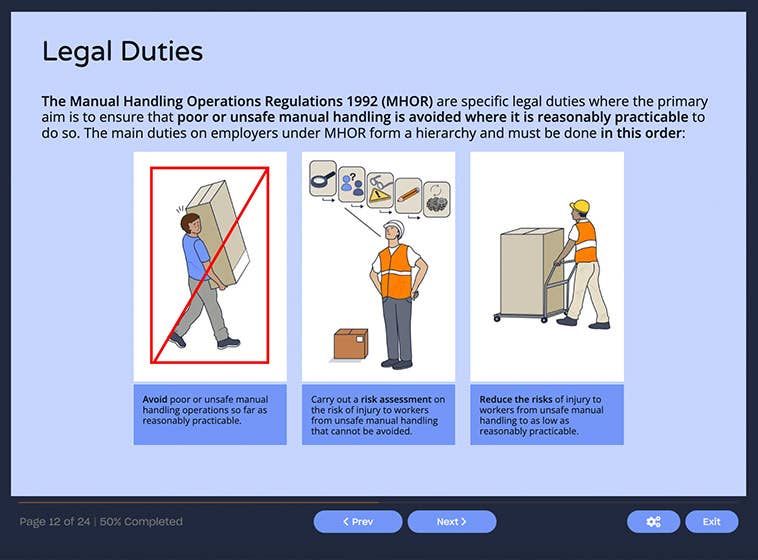
Each year in the UK thousands of workers suffer from injuries and aches, pain and discomfort in joints, muscles and bones. The risk of injuries from manual handling operations is increased where workers do not have the information or training necessary to enable them to work safely.
Employers have a legal responsibility to protect their employees from getting hurt or ill through work activities and/or work environment. Failure to comply with your duties and responsibilities as an employer may result in action being taken against you by the HSE or other enforcement agencies. By taking our Manual Handling Awareness training course, an employer will learn how to comply with the Manual Handling Operations Regulations 1992 (MHOR) and understand what their manual handling duties as an employer are.
Employees involved in the lifting, carrying and handling of objects and materials can be at risk of injury if not managed effectively. These injuries should not be accepted as an inevitable part of an employee’s work. Employers should reduce the risks of moving and handling activities by good design, by planning and by ensuring workers are correctly trained. By taking our Manual Handling Awareness training course, employees will learn the importance of following the training they've received, the work procedures in place, and good manual handling techniques. The course will explain how to follow the controls put in place by their employer, so they can fulfil their responsibility to look after their own health and safety and that of others at work.
This module outlines what manual handling is, the consequences of poor manual handling including injury and ill-health effects such as musculoskeletal disorders and the legal duties of employers and employees to avoid poor manual handling.
This module highlights what makes an effective manual handling risk assessment and outlines the five steps of a risk assessment, including ‘LITE’ to assess the load, individual, task and environment.
This module explains how to avoid manual handling either through elimination, or if not possible, automation or mechanisation. For tasks which are not reasonably practicable to avoid, guidance on controlling the risk is provided.
This module demonstrates how to carry out safe manual handling including lifting techniques, pushing and pulling loads, and team handling.
The online assessment is taken on completion of the training material. You will be asked 20 multiple choice questions with a pass mark of 80%. The answers are marked automatically so that you’ll instantly know whether you passed. If you don't pass don't worry! You can take the test as many times as you need with no extra charge.
The manual handling course is aimed at employees at all levels who may undertake manual handling operations, including the transporting of a load of items by lifting, lowering, pushing, pulling, carrying, manoeuvring, steadying or transporting thereof by hand or by bodily force. This includes, but is not limited to, professions such as:

In partnership with
Neil Murray
Health and Safety Consultant
Neil Murray is a vastly experienced and highly qualified health and safety professional who has held roles such as Senior Health and Safety Executive inspector, and Principal Inspector for Channel Tunnel construction. He has also held senior roles in an international infrastructure business, a major UK water utility company and a major construction group and provided management consultancy to numerous companies across a wide range of industries.
Neil has a wide expertise in many sectors, including construction, civil engineering, manufacturing engineering, water and waste utilities, education, heritage sites, public safety, rail construction and operation, transport, marine, waste management, engineering design and industrial and facilities management services.
Neil is a QSA auditor for RoSPA and also an author of published guidance on health and safety in the construction of the Channel Tunnel, work at height, major project management, and online training courses.
Yes, our Manual Handling course can act as evidence of industry-related training for accreditation applications, such as CHAS. It covers the requirements of the Manual Handling Operations Regulations 1992 (MHOR), which will help you understand how to fulfil the legal duties they set out. Knowledge of these topics form part of the training requirements set out by accreditation assessment bodies, so you must be able to demonstrate evidence of compliance in order for your application to be successful. Our course will contribute to the evidence you must provide during your application, to show that you have received the relevant training.
Please note that it will be down to each individual accreditation body to decide if our courses are sufficient for the training requirements of your specific business. This evidence only forms one part of your overall application process. It is up to you to prove you are fulfilling your legal duties and to supply sufficient evidence for everything the accrediting body requires in order for your application to be successful.
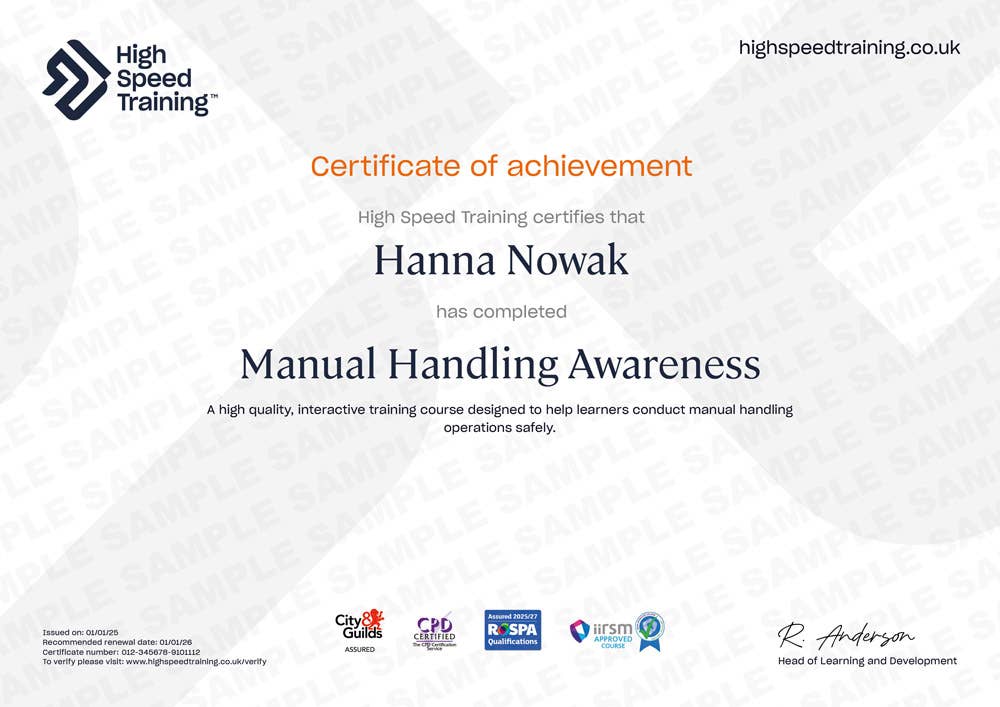
Yes - upon completion of your training you'll be able to download a PDF copy of your certificate immediately whilst your formal certificate will be sent by post the next working day.
All of our training is done within your web browser - there are no apps to download or software to install.
After picking the courses you need and completing your purchase, you will receive a confirmation email. To access our courses yourself or to distribute them to others you just need to click the ‘Get Started’ button within the email and select which option you want. You will then be able to add the course(s) into an existing account, or create a new account.
Of course just add the amount of courses you need and follow the purchase process. Please do be aware that it is one course per learner so they will all need their own course.
When buying courses for a team you'll also get access to our Management Suite free of charge. This is a tool that will allow you to allocate, track and review the training of your team.
Did you know? - We offer free training sessions on how to get the most from your Management Suite. To benefit from this, please contact: managersupport@highspeedtraining.co.uk to get your session booked in.
Yes, our bulk discounts are automatically applied to orders containing any combination of courses. We offer the following discounts on bulk purchases:
If you purchase 10+ courses you receive a 10% discount
If you purchase 50+ courses you receive a 20% discount
If you purchase 100+ courses you receive a 30% discount
If you purchase 500+ courses you receive a 40% discount
You can pay for our training using either a Debit or Credit card.
For companies ordering 5 or more courses, you’ll also be given the option to pay by invoice. If you would like to pay by invoice for fewer than 5 courses then please contact our Sales Team by calling 0333 006 7000 or emailing us at sales@highspeedtraining.co.uk.
Yes. You can use your username and password to log in and revisit the training material as many times as you like, even after completing the course.
No, we want our courses to work around you so there’s no time limit in which you must complete the training after making a purchase. You can also split your training over as many different sessions as you wish, as course progress is saved as you make your way through the training. You’re free to learn entirely at your own pace.
All of our courses are made by our in-house Learning Design team with an approach to solve real-world performance problems - not just to tick a box. This approach is built on the widely recognised Double Diamond framework, adapted to ensure that every course is engaging, effective and rooted in the learner's reality.
We collaborate with experts in the field to help pinpoint the specific barriers preventing safe or ideal behaviour. We identify opportunities for the course to solve these barriers, increasing the likelihood that training will translate into real-world action.
By training with us you can be confident that you are taking a course that has gone through rigorous internal reviews and external approvals to truly be built with the learner in mind.