

2026 Guide to Safety Culture
 14 min read
A positive safety culture is how people in your organisation manage risk. You can see an organisation’s safety culture by observing the way it conducts business and the actions of its employees as part of their day-to-day activities.
This guide is for UK workplaces and it explains what safety culture is and how to improve your workplace health and safety culture.
To see more from High Speed Training, add us as a preferred source on Google.

What is Safety Culture?
Your organisation’s safety culture is how it manages risk every day. It will be evident in how people operate during normal working activities and how they react when things don’t go to plan or when the work changes.
Safety culture includes:
- What your leaders prioritise and what they allow
- What your workers feel comfortable reporting and what they keep to themselves
- Whether your organisation learns from incidents and implements improvements that stick
- Whether you build and maintain competence through training, refreshers and effective supervision
- Whether controls are used consistently in the real environment in which people work, not just on paper

HSE guidance on organisational culture says “An organisation’s culture will influence human behaviour and human performance at work. Poor safety culture has contributed to many major incidents and personal injuries.”
Safety Culture and Safety Climate
Safety climate represents the current mood and refers to how safe people feel at work right now. It is a snapshot of you and your colleagues’ perceptions during a specific period that highlights how everyone feels about the priority given to safety in the workplace.
The safety culture of your organisation is the overall pattern of how people behave around risk in the workplace and the shared values, attitudes, assumptions and beliefs that you and your colleagues hold regarding safety. It also includes what your leaders reward and what they allow.
Why is Safety Culture Important in 2026?
Your safety culture decides what happens in the moments your procedures do not cover. Most incidents are not caused by people who did not know the rule. They are caused by people who knew it and worked somewhere that made following it harder than not following it.
The scale is well documented and the HSE estimates that workplace injury and new cases of work-related ill health cost Great Britain £22.9 billion in 2023/24 and that 40.1 million working days were lost to injury and ill health in 2024/25. Ill health accounts for the larger share of that cost. That matters, because ill health builds slowly and is easy to miss unless people feel able to raise it early.
In your own organisation the cost is more immediate and it appears as absence and cover, retraining, delayed work, higher premiums and time spent investigating something that was preventable. It also appears in who chooses to stay. Where people believe their employer takes their safety seriously, they are more likely to remain.
How the 2026 Employment Law Changes Affect Safety Culture
Some of the biggest influences on reporting confidence this year sit outside health and safety law.
New changes in employment law for 2026 could influence employee confidence in reporting their concerns as well as in the fairness and consistency that management has in responding to employee complaints. These can be factors that determine if an individual reports a problem before it is too late or does nothing and waits until something occurs.
There is a phased plan for the implementation of the Employment Rights Act 2025 which has resulted in changes to Statutory Sick Pay (SSP) that came into effect from 6th April 2026.
These changes mean SSP is payable on the first day of absence due to illness and removes the Lower Earnings Limit with the intention of reducing presenteeism and pay insecurity. When employers develop clear ways to manage sickness absences, workload and staffing pressures, it reduces the risk of employees attending work whilst ill and not reporting fatigue or dangerous working conditions.

Whistleblowing protections came into force in April 2026 and they include sexual harassment as a qualifying disclosure. Later, in October 2026, the requirement for employers to take all reasonable steps to prevent sexual harassment takes effect (this is further to the employer duty regarding sexual harassment prevention that came into force as part of the Worker Protection Act in October 2024), as well as an employer obligation not to permit third party harassment of their employees.
These changes to laws and regulations have relevance to safety culture, as employees are more likely to raise concerns with their employer if:
- the route for reporting is clearly defined
- their manager responds in a calm manner
- their employer takes action to address their concerns without the fear of retaliation or being blamed
What You May Notice About the Culture of Your Workplace
One of the best ways to see how strong a workplace’s safety culture is, is to see how employees act when there is no rule or policy to guide their actions. That is when priorities really shine through and whilst it can be uncomfortable, it is also incredibly useful.
When we interviewed the team at GOAT, a bar in Nantwich, co-owner Sam Hulme made the same point from the employer’s side. The owners cannot be present for every shift, so the training they put in place sets the benchmark for how they expect things to be done. General manager Lou works to a checklist of basic training that every new starter completes before their first shift, with any gaps identified at interview and addressed afterwards.
In a workplace with a strong safety culture:
- Workers use near misses to identify ways to improve the plan and execute it better on subsequent projects, even if that means a short delay now.
- Workers participate in the update of procedures when they are out of date or do not match the task and they expect those updates to be used.
- Managers and supervisors support this when pressure rises or deadlines are getting closer.

Comparatively in a workplace with a weak safety culture:
- Workers tend to report fewer hazards that actually exist because they are concerned about hassle or repercussions of reporting hazards, or because nothing changed last time.
- Supervisors continue to pressure employees to finish the project quickly even when safety controls are missing. You may also hear people try to defend unsafe practices by saying “we’ve always done it this way.”
How Safety Culture Develops
Safety culture develops in stages and most organisations sit somewhere in the middle of having a strong or a weak safety culture, with different parts of the business at different points. The HSE safety culture maturity model describes this progression in five stages.
The quickest way to locate yourself is to look at what happens after somebody raises a near miss.
- Emerging – Safety is treated as an obligation to the regulator. The near miss is not raised at all, or goes no further than the person who saw it.
- Managing – Systems and paperwork are in place and compliance drives them. The near miss is recorded. Whether anything changes depends on who receives it.
- Involving – Workers are asked to contribute. The near miss is discussed with the people who do the job, and procedures are amended as a result.
- Co-operating – Ownership is shared. Workers raise the near miss expecting something to change, and supervisors treat it as useful rather than inconvenient.
- Continually improving – The organisation looks for problems before they surface. People ask why the near miss was possible at all, and whether the same weakness exists elsewhere in the business.
You are unlikely to sit neatly in one stage. A site with excellent reporting may still have a department where people stay quiet, and pressure tends to pull an organisation back a stage rather than forward. Moving up is rarely a matter of new procedures. It usually means closing the gap between what your procedures say and what your supervisors accept when the work is running late.
Encouraging Employees to Report Safety Issues
To encourage employees to report safety issues employees must be confident that their reports are going to be acted upon and that the reporting process is straightforward and will be acted on in a timely manner.
The employee must also see results from the reporting process in order to continue to report concerns.
HSE guidance on involving your employees advises “If you are regularly approachable, employees are more likely to open up about the risks, especially if you then do something about the issues raised.”
Include reporting competence in your induction training and refreshers to cover what to report, where to report it, what good reporting looks like and what feedback to expect after making a report.
Christopher Kirby, Health and Safety Manager at Timothy Taylor’s brewery in Keighley, has seen the effect this can have. After the business broadened its awareness training, its near miss system recorded a rise in reports covering issues that had not previously been raised, particularly around PPE, banksman duties, working at height and manual handling. Operational teams also became more willing to take part when procedures and risk assessments were reviewed. A rise in reports of this kind is a sign that people are noticing more and saying so, which is what you want to see.

There are many different types of concerns that can arise and there are many different ways in which those concerns may need to be reported. Each type of concern should be directed to the most effective reporting route for that particular concern and each route of reporting should be communicated clearly to all employees and supervisors.
Possible routes for reporting concerns can be found below.
Concerns to be reported using the health & safety reporting route:
- Hazardous conditions
- Hazards
- Near misses
- Procedures that do not accurately describe the task
Concerns to be reported using the HR reporting route:
- Bullying
- Harassment
- Discrimination
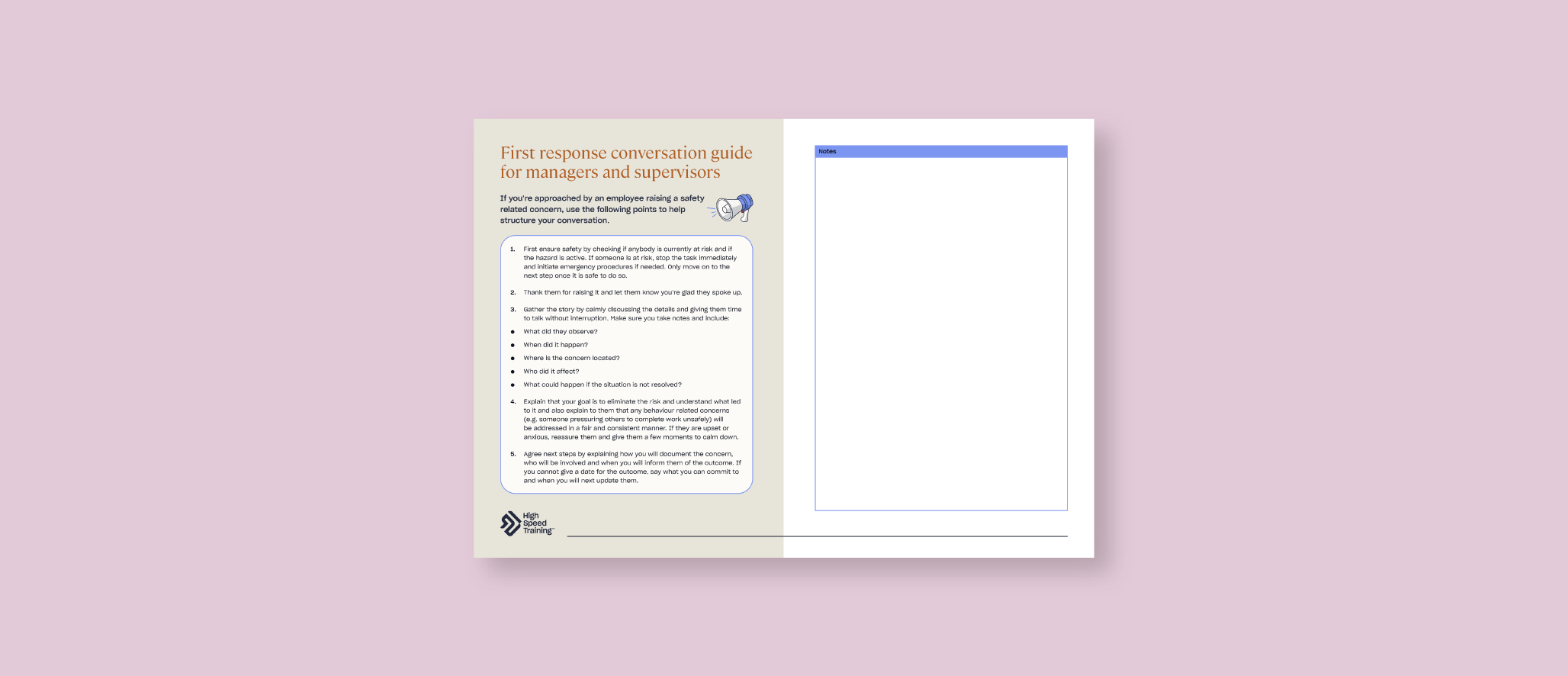
First Response Conversation Guide for Managers and Supervisors
If you’re approached by an employee raising a safety related concern, including hazards, near misses and hazardous conditions, use the following points to help structure your conversation. These conversations can feel uncomfortable and your colleague may worry they will be labelled as difficult or feel like they are getting others into trouble, so your tone matters.
- First ensure safety by checking if anybody is currently at risk and if the hazard is active. If someone is at risk, stop the task immediately and initiate emergency procedures if needed. Only move on to the next step once it is safe to do so.
- Thank them for raising it and let them know you’re glad they spoke up.
- Gather the story by calmly discussing the details and giving them time to talk without interruption. Make sure you take notes and include:
- What did they observe?
- When did it happen?
- Where is the concern located?
- Who did it affect?
- What could happen if the situation is not resolved?
- Explain that your goal is to eliminate the risk and understand what led to it and also explain to them that any behaviour related concerns (e.g. someone pressuring others to complete work unsafely) will be addressed in a fair and consistent manner. If they are upset or anxious, reassure them and give them a few moments to calm down.
- Agree next steps by explaining how you will document the concern, who will be involved and when you will inform them of the outcome. If you cannot give a date for the outcome, say what you can commit to and when you will next update them.
Following up on Actions Taken Regarding Safety Concerns
To encourage further reporting, show employees what was accomplished as a direct result of their concern. Remember to be specific.
When addressing issues try to:
- Prioritise controls that reduce or eliminate the risk at the point of origin where possible.
- Verify that the controls implemented are used effectively in the real work environment and that they are documented in the paperwork and training.
- Update the employee who raised the concern with a concise and clear explanation of what was done, when it was done and why it matters.
- Tell them how they can report if the control does not function correctly or if the risk returns.
Regular follow-ups and communication regarding the actions taken will build trust and promote the growth of your organisation’s health and safety culture.
How to Measure Safety Culture
When tracking progress do not rely on one number as it is unlikely to tell the whole story. It is best to use multiple metrics to show progress in your organisation’s safety culture, using both qualitative and quantitative data.
Qualitative includes what people say and/or show (e.g. interviews, focus groups and observations in the workplace). Quantitative is based upon numbers from sources such as survey responses.
Some practical measures to consider when measuring your safety culture:
- Reporting confidence – Ask people in your organisation if they feel comfortable reporting safety issues and if they know where to take their safety concerns.
- Hazard handling – How long does a hazard remain active before the risk is lowered and how long after that does it take for the hazard to be resolved.
- Repeat issues – If you see the same hazard recurring shortly after the risk was lowered or considered resolved, this may be an indicator that the underlying root cause was not resolved.
Training records deserve the same scrutiny as your reporting figures. Arsalan Zahid, Training and Development Manager at Mizkan Euro, treats a completion as a starting point rather than an answer. Online theory is followed by practical training delivered in house and he reviews how many attempts a learner has taken, so the record reflects understanding rather than persistence.
Always make sure that you check the story behind your metrics as some metrics may hide problems. A low incident rate is good if true, but you need to ensure this doesn’t in fact reflect a decrease in incident reporting. Conversely, high near miss reporting is only useful if you ensure follow-up is completed effectively. Ask what people do when work gets busy or when nobody is watching.
What Can You Do to Improve Safety Culture
Improvements are often small and structural. At Aerco, Supply Chain Manager Tom Peissel had three members of staff trained to carry out portable appliance testing rather than one, so the workload is shared and cover does not depend on a single person being available.
If you are an employee:
- Submit concerns regarding hazards as soon as possible and detail what you have found
- Complete training and refreshers specific to the work you do to maintain competence and safety
- Review any planned changes to your work and confirm the controls necessary for your safety are still in place
- Engage in the process and seek assistance if you are unsure about a safety matter
If you are a supervisor or manager:
- Use the first response conversation guide if a colleague raises a safety concern with you
- Protect employees from retaliation after reporting a concern
- Confirm people are competent for the task and provide coaching/supervision and training where needed
- Verify critical controls are employed during the performance of tasks and document and correct any gaps

If you are a senior leader or employer:
- Support visibility of follow-through by allocating resources, time and removing obstacles
- Monitor resolution quality and repeat issues then analyse the drivers behind these
- Set expectations for competence and ensure it is properly resourced with time for everyone to train and where necessary time to coach and supervise
- Clearly communicate consistent standards for supervisors/managers, employees and contractors, and walk the talk by personally leading by example
Competence matters most when there is no time to think. Emily Khan, a party host at Zig Zags Play & Party Area in Brierley Hill, had recently completed paediatric first aid training when a child at the centre began to choke. She has said the training was fresh enough in her mind that she felt able to act straight away. Training completed once and then left alone is not the same as competence kept current.
A positive safety culture is an important part of how workplaces manage risk every day and it will show in what leaders prioritise, what workers feel comfortable reporting and how consistently controls are used in real working conditions. When people are trained and competent for the task, managers respond calmly and fairly to concerns and actions are followed through and communicated. Hazards are also more likely to be raised early and resolved before anyone is harmed. Measuring progress and learning from incidents helps improvements to stick and supports a workplace where everyone plays their part in keeping each other safe.
Editor’s note: This guide was originally published in January 2026 and has been updated on 4th September 2026 for comprehensiveness.
Further Resources:


Post Author

You may also like