

Self-Care Menu: Free Template
 5 min read
The relentless fast pace of modern life can make it easy to forget to look after ourselves. Work stress, family drama and the world around us can quickly consume our minds, leaving little to no time for activities that feed the soul. We often don’t realise that we are in need of self-care until we experience burnout. However, self-care should not be seen as a last minute ‘cure’ but as the necessary, preventative steps we regularly take to look after ourselves; as the adage goes ‘prevention is better than cure.’
A self-care menu is an effective way to ensure you are consistently practising self-care and gradually building up good habits that help to relieve stress and bring enjoyment to life. In this article we will explore what a self-care menu is, why it is beneficial and provide some examples of what you can include in your own self-care menu. We will also provide a free downloadable template for you to create your own self-care menu.

What is a Self-Care Menu?
A self-care menu is a way to track self-care practices that can help to improve and maintain your physical and mental wellbeing. Self-care is the intentional practice of taking the time to do things that improve your overall wellbeing. This can help to reduce stress, improve health and increase one’s quality of life. The ‘menu’ aspect of a self-care menu acts as a framing device through which self-care activities are split into different categories.
The categories used in a self-care menu can vary greatly from person to person. Self-care menus typically divide activities by their regularity, familiarity or when they need to be engaged in. For example, some self-care menus may have a range of ‘emergency’ activities for high stress days. These activities may be categorised as ‘mains’ due to their importance, or ‘emotional’ as they are typically turned to during times of emotional stress. Comparatively, other self-care menus may categorise activities by frequency and list journaling as a ‘starter,’ that is to say something small that should be done at the start of every day.
How you categorise your own self-care menu will depend on how you intend on using the menu. As such, it is vital that the menu is catered to you and your needs. You might like the idea of a ‘Starter, Main, Desert’ menu model but if you struggle to organise activities in this manner it will quickly become ineffective. It can be helpful to think of a self-care menu as a list of activities. These activities can be turned to at different times and may require different levels of engagement. However, by beginning with a simple list you can see what activities you find enriching and fulfilling before grouping them according to how and when they may be of benefit.
As mentioned, self-care menus should be individualised to ensure they are effective. As such, there are a number of ways in which a self-care menu can itemise or category activities including:
- Starter, Main, Desert
- Breakfast, Lunch, Dinner
- Everyday, Every week, Every month
- Emotional, Physical, Relational
- 10 mins, 30 mins, 1 hour
However you decide to categorise your self-care menu try to avoid overcomplicating it with too many different groups. This can make your menu feel overwhelming and the act of picking one activity too stressful. It’s okay to start small with a simple three-way split and then make changes from there as and when necessary.

Self-Care Menu Ideas
Below you will find a list of some self-care ideas that you can add to your own self-care menu. A self-care routine of any kind should not be seen as a ‘to-do’ list but as a suggestion of activities that you know you enjoy doing or are excited to try. Remember, a self-care menu is not something that must be accomplished everyday in order to be successful, but something that you can dip into as and when needed and that helps to build healthy lifelong habits.
It’s worth noting that self-care does not just mean having a nice bath at the end of a stressful day or going for a run at the weekend. Self-care also includes the activities that we don’t want to do but we know will be beneficial in the long run such as budgeting for the month ahead, meal planning or improving your sleep schedule. ‘Boring selfcare,’ a phrase popularised by illustrator Hannah Daisy, refers to the ‘boring’ tasks and activities that are not particularly exciting but are undeniably beneficial for us. The importance of these activities should not be underestimated nor the tangible difference they can make on our lives and so it’s important to also include ‘boring’ self-care tasks when planning a menu.
Self-care menu ideas include:
- Skincare
- Baking/Cooking
- Painting
- Reading
- Journaling
- Volunteering
- Meditation
- Exercise
- Spending time with family and friends
- Watching sports
- Listening to music
- Arts and crafts
- Spending time in nature
- Travelling
- Reducing screen time
- Staying hydrated
- Developing a post-work wind down routine
- Improving sleep hygiene
- Mindfulness
- Listening to podcasts
Self-Care Menu Checklist 

The activities above have intentionally not been categorised so that you can divide them as you see fit. When creating a self-care menu it can be helpful to include a variety of different activities. This helps to keep things interesting and engaging therefore making it more likely that you will be consistent with these activities. To make this variety of choice less overwhelming it can be helpful to include activities that suit a specific, pre-determined need. For example, physical activity can be incredibly beneficial for one’s mental health, so it’s important that at least one self-care activity includes physical movement.
To ensure that you have a variety of activities you can create a checklist. As mentioned, self-care menus and self-care as a whole is not set in stone and adaptability and flexibility is an important part of making sure your self-care is realistic and sustainable. Therefore, a checklist shouldn’t be used dogmatically but as a way to include a variety of activities and to help you engage in a range of different ones.
Useful categories for a self-care checklist include:
-
- Something physical
-
- Something personal
-
- Something social
-
- Something challenging
-
- Something easy
-
- Something intellectual
-
- Something practical
-
- Something financial
-
- Something stimulating
-
- Something calming
-
- Something you’ve been procrastinating
It can also be helpful to categorise your self-care menu by how long activities take so that you have a range of options to suit your schedule. This could include:
-
- Quick bites – activities that take 5 – 10 mins
-
- Hearty mains – activities that take 30 mins to an hour
-
- Special occasions – activities that require longer investment, such as learning a new skill
The list above is not exhaustive however it highlights the different types of activities that can be encompassed under the umbrella of ‘self-care.’ You can make the categories of your checklist whatever you want and you can use them to ensure you are providing yourself with a diverse and satisfying self-care menu.
Self-Care Menu Template
Below you will find a free downloadable self-care menu template that you can use to create your own self-care menu. The menu has been split into three editable categories for you to divide self-care activities as you wish. As mentioned, it can be helpful to group activities based on when they may be helpful, how long they take or the best time of day to partake in that activity. However, you can tailor the menu to your own needs and find a format that works for you.
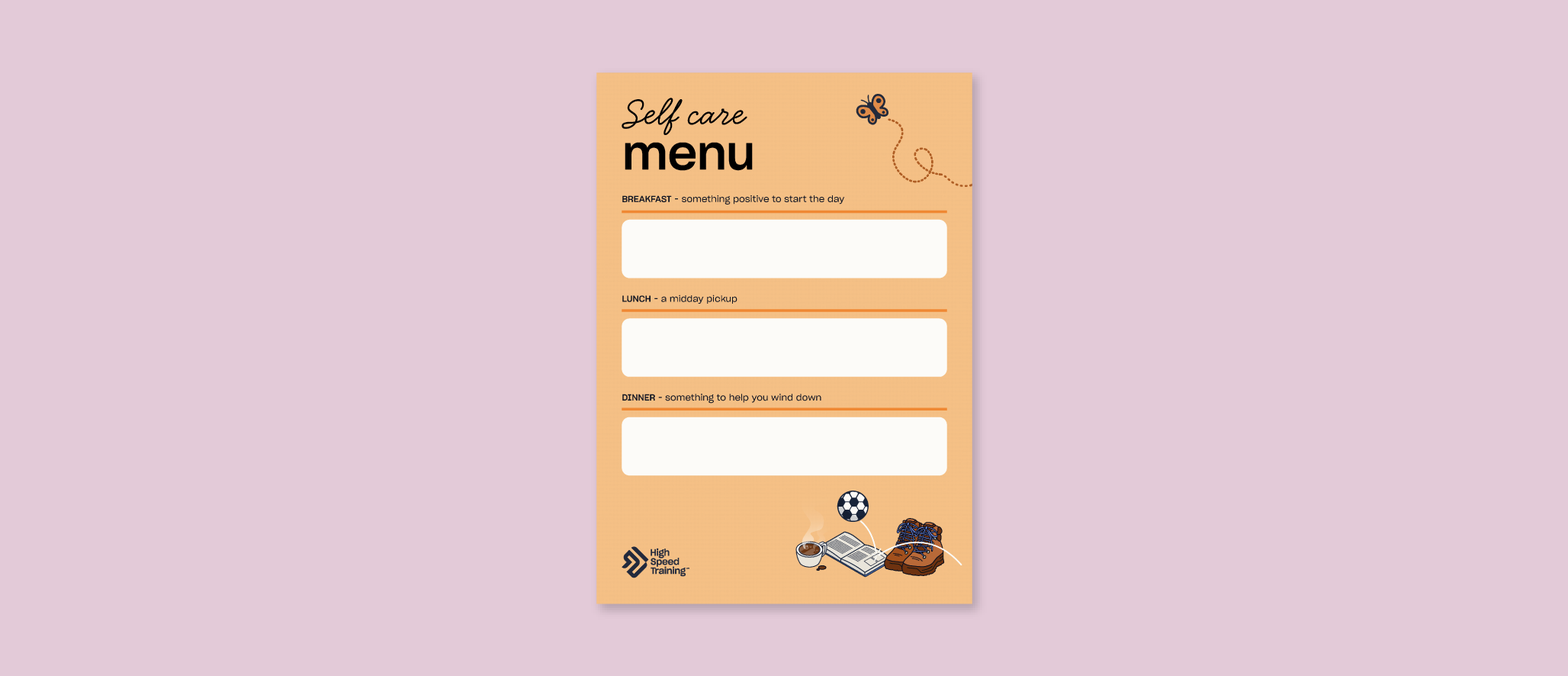
A self-care menu is a useful tool to ensure that you are taking the time to look after yourself, mind, body and soul. Self-care is not an afterthought and a self-care menu should not be seen as a to-do list of activities that must be adhered to. A self-care menu, just like self-care, is an important way to look after yourself, enrich your life and participate in activities that help you to relax and unwind.
Further Resources:
- Mental Health Awareness Course
- How to Change Negative Thought Patterns
- Stress Management Quiz
- How to Talk About Mental Health


Post Author