
PAT Testing Course
Quantity: 1
Duration 1-2 hours
Last audited 5th March 2026
100% online training
Start when you like
Learn on any device (desktop, mobile or tablet)
Instant assessment and result
1 learner per course
Train teams of all sizes
Bulk discounts starting at 10% off 10 courses
Pay by invoice with 30 day payment terms available (5+ courses)
Includes a 10% discount for 10+ courses
Electrical equipment is used in virtually every workplace, and because it can pose serious health and safety risks, the law requires all such equipment to be properly maintained.
This PAT testing course will explain the safety risks, legal requirements and control measures needed to safely use, inspect, test and maintain electrical equipment in low-risk workplaces.
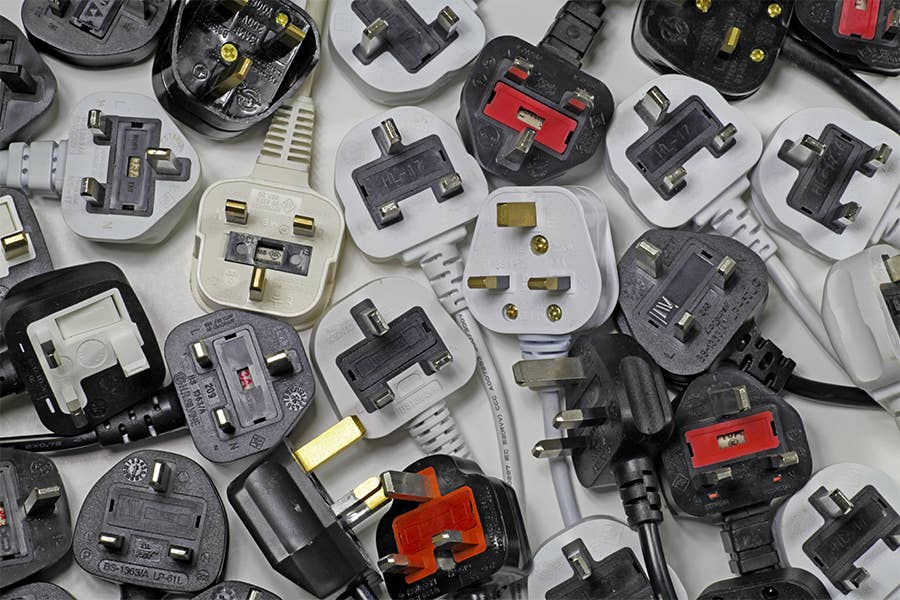
This course follows the In-Service Inspection and Testing of Electrical Equipment (ISITEE) standard. Under ISITEE, the term 'electrical equipment' includes all portable appliances, plug-in appliances, IT equipment, extension leads, detachable cables and any equipment connected via a plug and socket.
Note that this course provides awareness-level knowledge. In low-risk environments, such as offices, it provides sufficient knowledge to allow the learner to conduct PAT tests, but in higher-risk areas, a greater level of knowledge is required, and this course is not suitable.
100% online training
Access anywhere
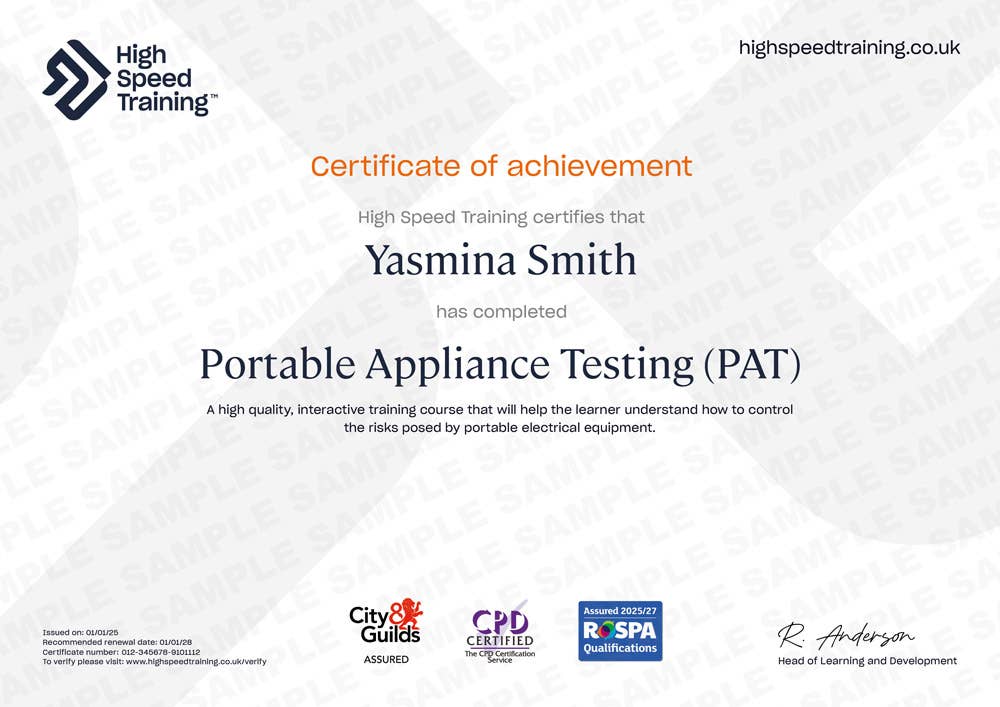
Same day digital certificate
Printed certificate posted next working day
Full audio voiceover
Assessment retakes at no extra cost
Learn at your own pace with no completion deadlines
Developed by health and safety professionals
City & Guilds Assured
Accredited by CPD and assured by RoSPA Qualifications
Bulk discount for orders of 10+ courses
Save on our courses when you buy more training upfront. Lock in a better price now and access the training whenever you need to. You can mix and match any of our courses too and get the discount off your whole order.
10+ courses = 10% off
50+ courses = 20% off
100+ courses = 30% off
500+ courses = 40% off
By the end of this course, you will understand:
If your employees are working from home and use portable electrical equipment (such as laptop computers, display screens and cameras) as an employer, you are responsible for ensuring that their equipment is safe and without risks, including portable electrical equipment.
While there are no UK PAT Testing Regulations, employers have a legal duty to ensure that electrical equipment used for work purposes is safe under the following legislation:
Employers of home workers must maintain any equipment used for work purposes. This may involve arranging for someone to go to their home to check the equipment or having the employee send equipment to a central office for inspection, testing, and maintenance where required.
Employers need to ensure that those who use electrical equipment have received sufficient instruction, information and, where necessary, training to use the equipment safely and so they know to report any issues. This PAT course will be useful training for anyone who may be involved in checking the work equipment of home workers and carrying out PAT tests, based on the employer's risk assessment.

City & Guilds Assured
Thoroughly reviewed independently by City & Guilds learning and development experts, this course is approved as City & Guilds Assured. High Speed Training is the first e-learning provider to have online courses awarded City & Guilds Assured status.
Accredited by CPD
All of our courses are accredited by the CPD Certification Service as conforming to universally accepted Continuing Professional Development (CPD) guidelines.
Assured by RoSPA Qualifications
This course is also assured by the Royal Society for the Prevention of Accidents through their RoSPA Qualifications Assurance System, as providing up-to-date, quality and content-approved training.
Recommended renewal:
3 years
What does this mean? This certificate does not have an expiry date, however, based on industry best practice guidelines there is a recommended renewal period.
Our in-house Learning Designers develop all of our courses to give you and your learners the most engaging training possible.
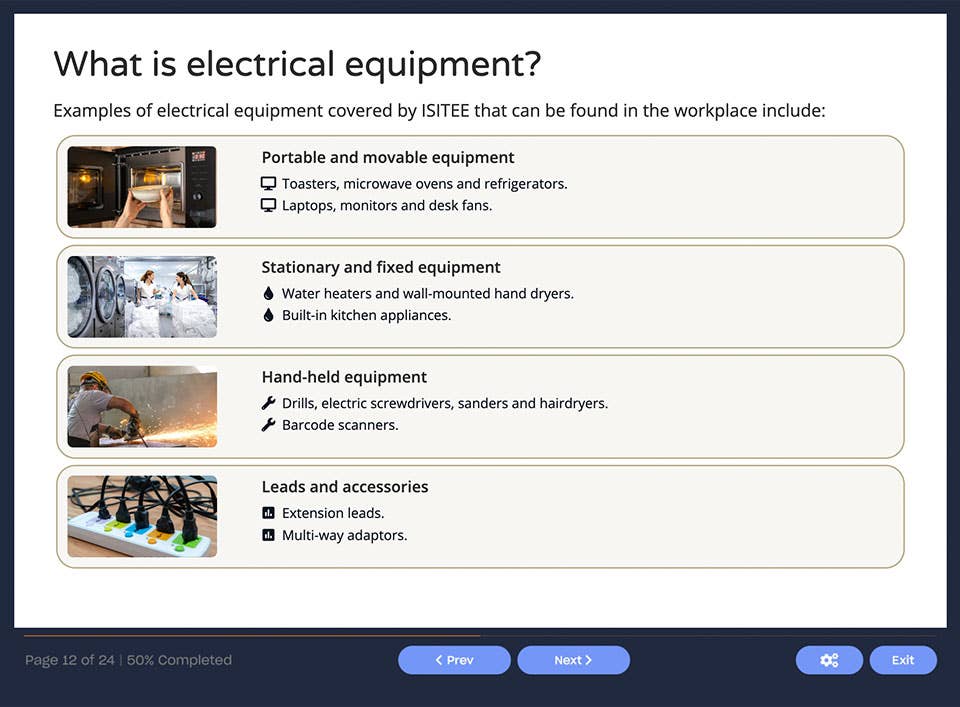
What is electrical equipment? What are the classes of electrical equipment? What are the safety risks, legislation and legal duties?
What is a risk assessment? Who should carry out risk assessments? Step 1: identify the hazards; Step 2: who might be harmed and how; Step 3: evaluate and control the risks; Step 4: record your findings; Step 5: review and update; emergencies and accidents; and personal dynamic risk assessments.
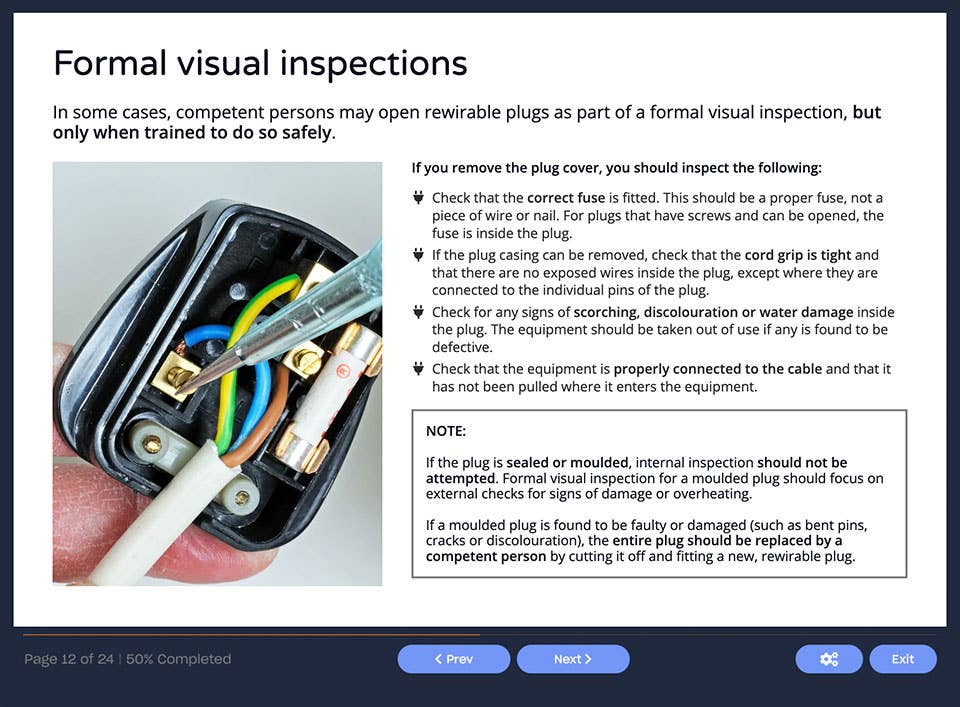
Recap of class I and class II equipment, pre-use checks, formal visual inspections, frequency of inspections and testing, failed inspections and recording findings.
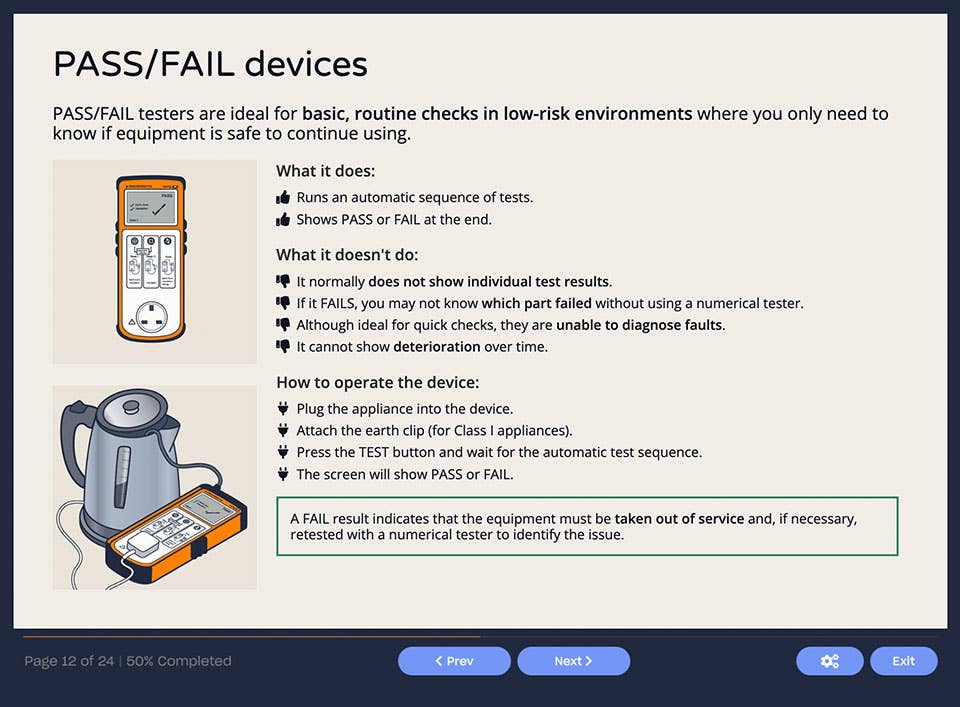
Preparing for testing, PAT testing devices, interpreting test results, failed tests and recording findings.
The online assessment is taken on completion of the training material.
You will be asked 20 multiple choice questions with a pass mark of 80%.
The answers are marked automatically so that you’ll instantly know whether you passed. If you don't pass don't worry! You can take the test as many times as you need with no extra charge.
This course is suitable for anyone with a responsibility for health and safety in low risk workplaces such as offices. It is suitable for all employees at any level of the business, as it introduces the learner to and gives them basic knowledge of portable appliance testing; it does not require any previous training.
This course is not suitable for employees working in environments that are considered higher than low risk. This includes schools, gyms and any industrial premises.
All electrical equipment requires a different method of testing. It is within our best interest to provide you with accurate advice and information, but it's the duty of the individual responsible for appliance testing to apply the techniques discussed in this course safely and with full confidence.

In partnership with
Graham Parker
Director & Owner of ConsultSafe Ltd & Non Exec Director at RoSPA
Graham has 30 years of health and safety experience in a variety of high and low risk environments, across real estate, facilities management, logistics, aviation and retail. His specialist focus is promoting and making pragmatic Health and Safety a core and integral part of good leadership.
Graham is the Director and Owner of ConsultSafe, one of the UK's leading occupational safety & health experts. They offer bespoke safety services for organisations, covering OSH Strategy Development, Board Guidance, Interim Directorship, Risk Management, Management Systems, audits and project work.
Graham is a Fellow and Past President of the Institution of Occupational Safety and Health (IOSH). He is also a Fellow of the International Institute of Risk Safety Management (IIRSM), a Professional Member of The American Society of Safety Professionals (ASSP), International Member of the Canadian Society of Safety Engineers (CSSE), Certified Member of Institute of Workplace and Facilities Management (IWFM) while also being one of the leading RoSPA Awards Excellence Ambassadors.
All of our training is done within your web browser - there are no apps to download or software to install.
After picking the courses you need and completing your purchase, you will receive a confirmation email. To access our courses yourself or to distribute them to others you just need to click the ‘Get Started’ button within the email and select which option you want. You will then be able to add the course(s) into an existing account, or create a new account.
Of course just add the amount of courses you need and follow the purchase process. Please do be aware that it is one course per learner so they will all need their own course.
When buying courses for a team you'll also get access to our Management Suite free of charge. This is a tool that will allow you to allocate, track and review the training of your team.
Did you know? - We offer free training sessions on how to get the most from your Management Suite. To benefit from this, please contact: managersupport@highspeedtraining.co.uk to get your session booked in.
Yes, our bulk discounts are automatically applied to orders containing any combination of courses. We offer the following discounts on bulk purchases:
If you purchase 10+ courses you receive a 10% discount
If you purchase 50+ courses you receive a 20% discount
If you purchase 100+ courses you receive a 30% discount
If you purchase 500+ courses you receive a 40% discount
You can pay for our training using either a Debit or Credit card.
For companies ordering 5 or more courses, you’ll also be given the option to pay by invoice. If you would like to pay by invoice for fewer than 5 courses then please contact our Sales Team by calling 0333 006 7000 or emailing us at sales@highspeedtraining.co.uk.
Yes. You can use your username and password to log in and revisit the training material as many times as you like, even after completing the course.
No, we want our courses to work around you so there’s no time limit in which you must complete the training after making a purchase. You can also split your training over as many different sessions as you wish, as course progress is saved as you make your way through the training. You’re free to learn entirely at your own pace.
All of our courses are made by our in-house Learning Design team with an approach to solve real-world performance problems - not just to tick a box. This approach is built on the widely recognised Double Diamond framework, adapted to ensure that every course is engaging, effective and rooted in the learner's reality.
We collaborate with experts in the field to help pinpoint the specific barriers preventing safe or ideal behaviour. We identify opportunities for the course to solve these barriers, increasing the likelihood that training will translate into real-world action.
By training with us you can be confident that you are taking a course that has gone through rigorous internal reviews and external approvals to truly be built with the learner in mind.