

How to Conduct an Exit Interview: Free Template
 7 min read
When a new employee starts a business considerable time and effort is put into their onboarding. Policies, procedures and expectations are made clear from the get go as well as their legal rights and business benefits. It can be easy to assume that a comparable level of care is not necessary when offboarding an employee, however this is far from the case. A considerate and well planned offboarding process is a valuable opportunity to gain important insight, identify areas for improvement and ensure that a departing employee feels respected and appreciated. In this article we will explore what an exit interview is and how it can benefit your business. We will also discuss how you can conduct an exit interview in your workplace and provide you with a free downloadable template to use as part of the process.
What is an Exit Interview?
An exit interview is a formal interview that is conducted when an employee is leaving a business. They are typically conducted by someone from HR and they are an essential part of the offboarding process.
Exit interviews provide departing employees with the opportunity to share feedback about their time at the organisation. This can then be used to help a business grow and improve. Exit interviews also provide managers with the chance to recognise the hard work of the departing employee, reflect upon their performance and, where appropriate, encourage the employee to stay.

It’s worth noting that exit interviews are not a legal requirement in the UK. Businesses do not have to conduct one nor do departing employees have to attend them. However, just because they are voluntary does not mean they are not important. It is often regarded as best-practice to conduct exit interviews as a means to gather feedback, improve retention and to ensure that a departing employee leaves on good terms.
Benefits of an Exit Interview
As mentioned, exit interviews are not a legal requirement however they can be incredibly beneficial for the business, the departing employee and remaining employees.
The benefits of an exit interview include:
- Feedback – Exit interviews can help improve company culture as they give departing employees the chance to offer honest feedback. Employees should always feel that they can share concerns with their managers however the reality is that many employees worry about the ramifications of doing so. Departing employees are likely to be a bit more honest and open. This does not mean that their feedback will automatically be negative, however it may be more direct. This feedback can provide vital information as to what needs changing or improving within the business or within specific teams.
- Improved retention – The feedback that a departing employee provides can be used to improve the experiences of remaining employees. This in turn will help to improve employee retention as employees see tangible change that reflects their concerns. It’s not ideal for issues to only be brought up during an exit interview, however, rather than viewing the feedback as being ‘too late’ it can be beneficial to see it as a means to improve so that other employees are more willing to stay.
- Maintaining good relationships – It should not be assumed that a departing employee is leaving because they hated their job or the business. There are a myriad of reasons as to why someone may leave a job and some departing employees may be open to the idea of returning should the opportunity arise. An exit interview helps to ensure that an employee leaves on good terms, feeling listened to and appreciated. This can help to maintain their positive image of the business and make them more receptive to future opportunities with the company should they arise.

- Trend recognition – As mentioned, it is not ideal for issues that have caused an employee to leave to only be bought up during an exit interview. Employees should feel safe to share any concerns as and when necessary. However, should this not be the case, exit interviews can help to highlight trends that may be causing employees to leave. For example, an exit interview may highlight that employees working in the tech department tend to leave after 2 years and that it is common for them to mention burnout and unrealistic workloads as reasons for them leaving. This insight highlights potential issues in the running of that department thereby providing an opportunity for significant change and improved employee retention.
- Business reputation – An exit interview signals to prospective and existing employees that they matter at all points of their life cycle within the business. Departing employees are not ‘abandoning’ the business and an exit interview demonstrates care for them and a final chance for them to feel heard. This is a positive signifier to all that an organisation cares about improvement and the wellbeing of all employees, even once their time with the business has ended.

Looking for More?
Our wide range of Business Essentials courses, including courses such as Leadership and Management training, provide you with the skills and knowledge to confidently support employees at all stages of their career.
How to Conduct an Exit Interview
As exit interviews are voluntary they should not be seen as a tick box exercise; if you’re going to conduct them, ensure that you are conducting them well. A successful exit interview will provide vital feedback, ensure the departing employee feels heard and maintain good relationships.
Below you will find guidance on how to conduct an exit interview however it’s important that you tailor the experience to your business and the role of the departing employee. There may be additional questions you wish to ask or their comments in response to a question may offer more useful insight than continuing with the prepared questions. Feel free to tweak your exit interview process to ensure you gain the best insight to evoke tangible change in the workplace.
To conduct an exit interview:
- Ask the departing employee if they would like to take part in an exit interview. As mentioned, exit interviews are not mandatory and whilst they are regarded as best practice a departing employee should not be forced or pressured to do one. If an employee feels pressured to have an exit interview they are less likely to be honest and provide valuable feedback. It can be a good idea to provide employees with an exit interview questionnaire about their overall experience, reasons for leaving and suggestions for improvement. If a departing employee agrees to an exit interview the questionnaire can provide a useful starting point and guide the conversation. Comparatively, if a departing employee does not want to have an exit interview, then the questionnaire can act as a medium through which they can share their thoughts without feeling the pressure of talking to someone face-to-face.
- Set clear expectations. A departing employee may question what the point of an exit interview is if they are leaving the company and won’t experience any of the changes themselves. They may also worry that the interview is a final chance to berate them. Setting clear expectations reaffirms that exit interviews are rooted in gathering constructive feedback so that the business can grow and improve. This can help departing employees feel at ease and therefore more likely to be honest about their experience.

- Decide when and where the interview will take place. It’s advisable to schedule an exit interview for the departing employee’s final week but not necessarily their final day. Final days can be emotional times with fond farewells and time to reflect on what has been achieved. Shoehorning an exit interview into someone’s last day can make their day feel rushed and the interview like an afterthought. Instead, schedule the meeting for a different day and allow ample time for the departing employee to say as much, or as little, as they want. It can also be helpful to have the exit interview in a more neutral setting or even online. Exit interviews should be conducted privately and in a location where other employees cannot overhear. However, they do not necessarily need to be conducted in the CEOs office or a large meeting room.
- Decide who will conduct the interview. Exit interviews are typically conducted by a member of HR. Depending on the size of your organisation and the nature of your business you may want to include line managers or senior members of staff so that they can hear any feedback directly. However, it’s important that the departing employee feels comfortable and not ganged up on. Limiting the number of attendees and asking the departing employee if they are comfortable with those who will be attending can help them to feel safe to express their views.
- Conduct the interview in a positive manner. As mentioned, exit interviews are a final touchpoint for departing employees. They have not ‘abandoned’ the business and whilst their departure may necessitate staffing changes, they should not be approached as though they have caused an inconvenience. Be respectful and practice active listening. Take notes throughout and ensure that you are giving the departing employee time to speak and fully explain what they want to share.
- Collate and share feedback. A successful exit interview will ideally highlight areas for improvement. This valuable insight will help to improve business performance and staff retention when acted upon and so collating feedback is an important part of ensuring exit interviews are effective. Aim to keep the feedback as objective as possible and avoid detailing personal grievances that may not reflect the workplace as a whole.
Example Exit Interview Questions
The questions that you ask during an exit interview will greatly depend on the departing employee’s role. It may also be impacted by whether you are hoping to get the employee to stay. Nevertheless, example questions to ask during an exit interview include:
- What prompted you to leave?
- Before deciding to leave did you explore whether there were options here that would enable you to stay?
- Did your role match the expectations you had when you initially started?
- What elements of your job did you enjoy the most?
- What elements of your job did you find the most challenging?
- Did you feel valued and appreciated for the contributions that you made during your time here?
- Do you feel like there were viable opportunities for you to grow here?
- Did you receive adequate training to support you in your role?
- Would you recommend the business to others as a good place to work?

Exit Interview Template
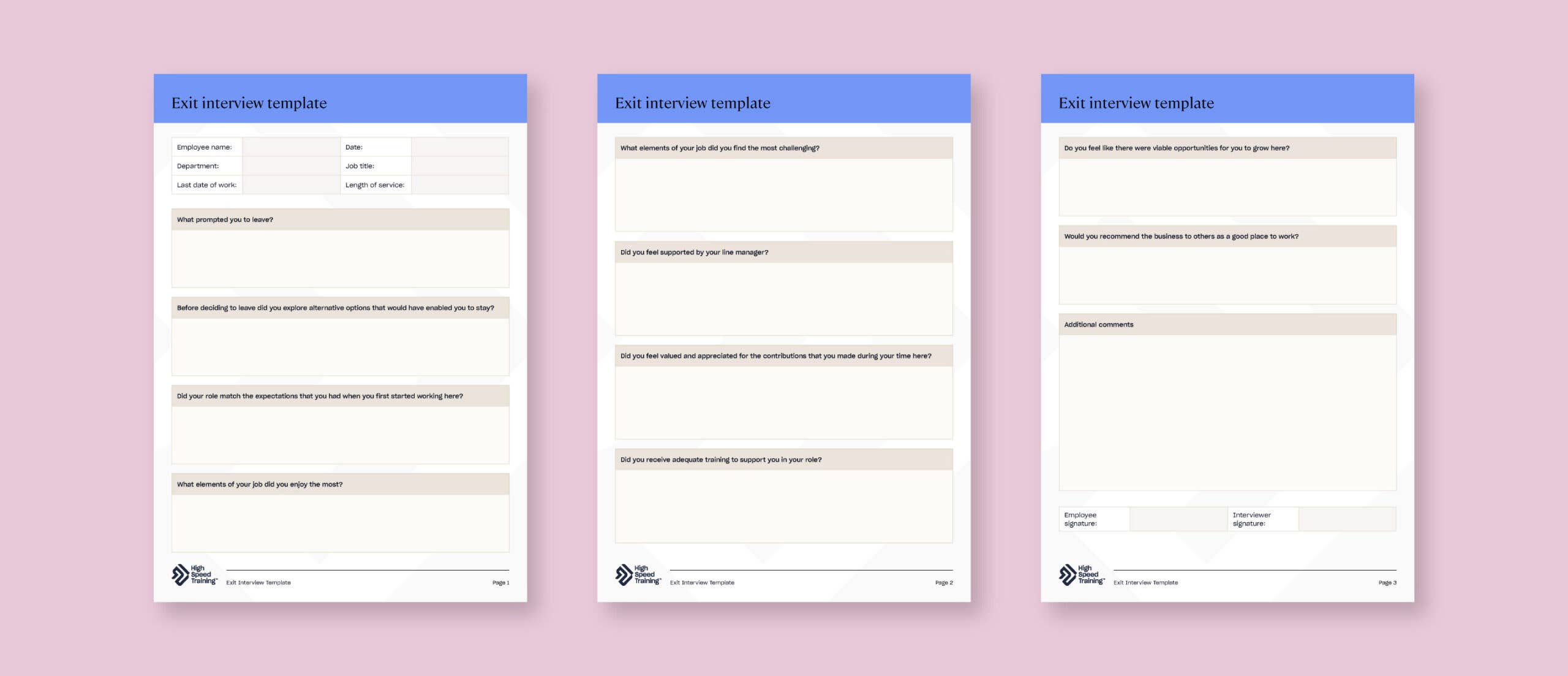
Below you will find an exit interview template that you can use to conduct your own exit interview. As mentioned, exit interviews are most successful when they are tailored to the specific individual and their role within the business. As such, the template should be viewed as a handy guide rather than a checklist of mandatory questions.
You may find that some questions are not relevant to the departing employee’s role or the employee may answer a question in a way that encourages you to dig deeper into a different or unexpected topic. Flexibility and adaptability is important during an exit interview so that the departing employee feels heard and so that the feedback that you receive is useful and can be acted upon. If you stick too rigidly to a template the departing employee may feel as though they are not being listened to as the questions don’t reflect what they are saying.
As mentioned above, it is a good idea to ask the departing employee whether they would like to have an exit interview or not. Exit interviews are voluntary and forcing a departing employee to participate may result in an unnecessarily negative interaction which neither provides useful feedback nor enables things to end on good terms. If a departing employee declines an exit interview you could ask them to instead fill out a questionnaire using the same questions provided in the template. This enables the departing employee to be as detailed or as brief as they wish without the pressure of a face-to-face interaction.
You may also choose to use the template as a pre-interview questionnaire to get an idea of some key discussion points before the face-to-face interview. If you choose to do this, avoid following the template as rigidly during the interview so that the employee does not feel as though they are repeating themselves. Instead, highlight areas which warrant more exploration. For example, if an employee mentions during the pre-interview questionnaire that tensions within their team were a driving factor in them leaving, asking them again during the interview is redundant. Instead ask the employee to expand on this point or whether there is more that they want to add.
There is also a section for additional comments. You can add further questions here or ask the departing employee if there is anything more that they wish to add that may not have come up from the previous questions.
Exit interviews are a valuable way to gain important insight. A departing employee can provide tangible feedback that can improve your business and the work lives of remaining employees. When encouraged to share feedback in a positive manner, departing employees can offer advice that enables your organisation to grow and them to leave with a positive opinion of your company. Exit interviews should not be overlooked simply because they are voluntary and when conducted well they can offer vital guidance on how to improve.
Further Resources:
- 2026 Guide to Safety Culture
- Employee Retention Strategies: Guidance on Retaining Staff
- Business Essentials Courses




Post Author