
What are the Consequences of Poor Manual Handling?
 6 min read
Manual handling is a common part of work, whether that involves lifting boxes, moving equipment, carrying materials or moving people. While these tasks can be a normal part of the working day, poor manual handling can cause immediate injuries as well as long-term health problems, particularly when tasks are repetitive or involve heavy, awkward or unstable loads. In this article, we’ll outline who is most at risk from poor manual handling, the consequences of poor manual handling and how the right control measures can help prevent injuries.
Who is Most at Risk From Manual Handling?
Manual handling is common across many different workplaces, so anyone who is required to lift, lower, push, pull, carry or move something could be at risk. However, some workers are more likely to experience manual handling injuries because of the nature or frequency of the tasks they carry out. Yet the risk is not necessarily determined by someone’s job title; a person who only occasionally carries out a manual handling task can still be injured if the task is hazardous or performed incorrectly.
Industries and roles where manual handling may present a greater risk include:
- Construction workers, who may regularly lift and carry building materials, tools and equipment, often in restricted or uneven working environments.
- Warehouse and distribution workers, who may repeatedly lift, carry, stack and move goods throughout a shift.
- Health and social care workers, who may need to support people with mobility, reposition individuals or assist with transfers.
- Agricultural workers, who may handle animals, tools, feed, machinery and other heavy or awkward loads.
- Manufacturing workers, who may undertake repetitive lifting, pushing, pulling or handling tasks as part of production processes.
- Retail and hospitality workers, who may move stock, crates, deliveries, furniture and equipment.
- Cleaners and facilities workers, who may regularly move equipment, supplies, bins and other loads.
- Office workers, who may occasionally need to move furniture, boxes, IT equipment or office supplies.

Manual handling injuries can happen for a number of reasons, including as a result of the way a task is organised, the working environment and whether suitable equipment is available. Common manual handling mistakes include:
- Lifting a load that is too heavy or bulky for one person.
- Trying to lift or move a load without first considering how the task should be carried out.
- Bending, twisting or stretching while lifting.
- Carrying a load over a long distance when mechanical assistance could be used.
- Lifting from floor level or above shoulder height unnecessarily.
- Trying to move a load that is unstable or difficult to grip.
- Rushing because of time pressures or tight deadlines.
- Continuing to carry out a task despite experiencing pain or discomfort.
- Failing to use available handling aids or equipment.
- Assuming that a task is safe simply because it has been carried out many times before.
Consequences of Poor Manual Handling
The consequences of poor manual handling can be acute or long-lasting. Some injuries happen suddenly, while others develop gradually after repeated strain. The effects can also extend beyond physical injury, potentially affecting a person’s ability to work and their wider wellbeing.
Short-Term Manual Handling Injuries
A single incident can result in an immediate injury, particularly if someone loses their grip, drops a load or attempts to move something in an awkward position. These injuries that initially appear minor can go on to affect someone’s ability to work and carry out everyday activities. For example, a worker who strains their back while lifting a box may need to take time away from work while they recover. A more serious injury could require medical treatment or result in a longer period away from work.
Possible short-term injuries include:
- Sprains and strains.
- Muscle pulls and tears.
- Cuts, grazes and bruises.
- Fractures and broken bones.
- Crush injuries.
- Injuries caused by slips, trips and falls.
- Damage caused by being struck by a falling or moving load.
Long-Term Musculoskeletal Disorders
Not all manual handling injuries happen suddenly. Repeated lifting, carrying, pushing or pulling can gradually place strain on the body’s musculoskeletal system. Musculoskeletal disorders (MSDs) affect the muscles, joints, tendons, ligaments and nerves in areas including the back, neck, shoulders, arms, hands, hips and legs.
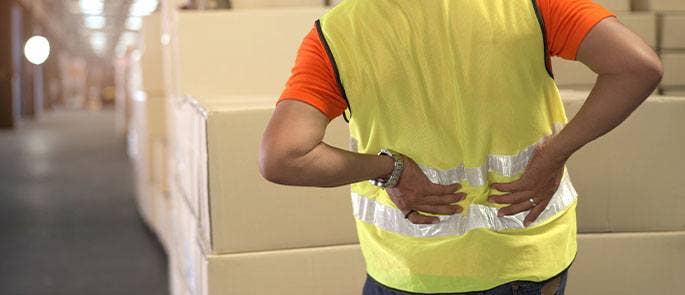
The risk of MSDs can be particularly significant where workers are repeatedly handling heavy or awkward loads, working in uncomfortable positions or carrying out tasks in cramped environments. MSDs can have a significant impact on a person’s quality of life as well as their ability to work.
Symptoms of MSDs can vary depending on the condition but may include pain or discomfort, stiffness, swelling or inflammation, reduced movement, muscle weakness or fatigue, aching or tenderness and numbness.
How Poor Manual Handling Affects Mental Health and Wellbeing
A serious or long-term manual handling injury can also affect a person’s mental wellbeing, as well as their physical health. Living with ongoing pain, reduced mobility or uncertainty about when they’ll be able to return to normal activities can be difficult. Someone who is unable to work or participate in activities they previously enjoyed may also experience frustration, worry or stress.
This doesn’t mean that poor manual handling directly causes a specific mental health condition. Rather, physical injury and long-term pain can have wider effects on a person’s wellbeing and daily life.
The Effects Poor Manual Handling Has on the Workplace
Poor manual handling can also have consequences for employers and colleagues. When an employee is injured, the effects can extend beyond the individual. For example, an injury may result in:
- Time away from work due to sickness absence.
- Reduced productivity while a worker recovers or works with restricted duties.
- Pressure on colleagues who may need to cover additional work.
- Disruption to normal workplace activities.
- Damage to stock, equipment or property.
- Potential investigation following a workplace incident.
- Financial and legal consequences where health and safety duties have not been met.

Employers have duties under the Health and Safety at Work etc. Act 1974 and the Manual Handling Operations Regulations 1992 to manage workplace risks. By law, employers should avoid hazardous manual handling activities wherever possible. Where hazardous manual handling cannot be avoided, the task should be assessed and appropriate steps taken to reduce the risk of injury.

Want to Learn More?
Understanding the risks associated with manual handling can help employees recognise hazards and work more safely. Our Manual Handling Awareness Training covers the risks associated with manual handling, how to carry out a risk assessment and how to implement appropriate control measures.
How to Prevent Injuries: Key Control Measures
Preventing manual handling injuries isn’t simply about teaching employees how to lift correctly. The most effective approach is to look at whether hazardous manual handling can be avoided in the first place and then consider how the remaining risks can be reduced. Employers should assess the work being carried out and introduce suitable control measures. These may include the following key manual handling control measures:
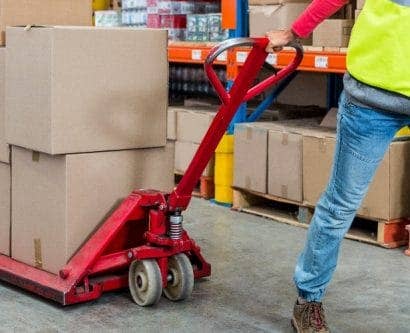
Avoid hazardous manual handling where possible – the first question should be whether the manual handling task needs to be carried out at all. Where reasonably practicable, consider whether the movement can be eliminated, automated or carried out using mechanical assistance. For example, a workplace may be able to use a trolley, hoist, conveyor or other suitable handling aid rather than requiring an employee to manually lift and carry a heavy load.
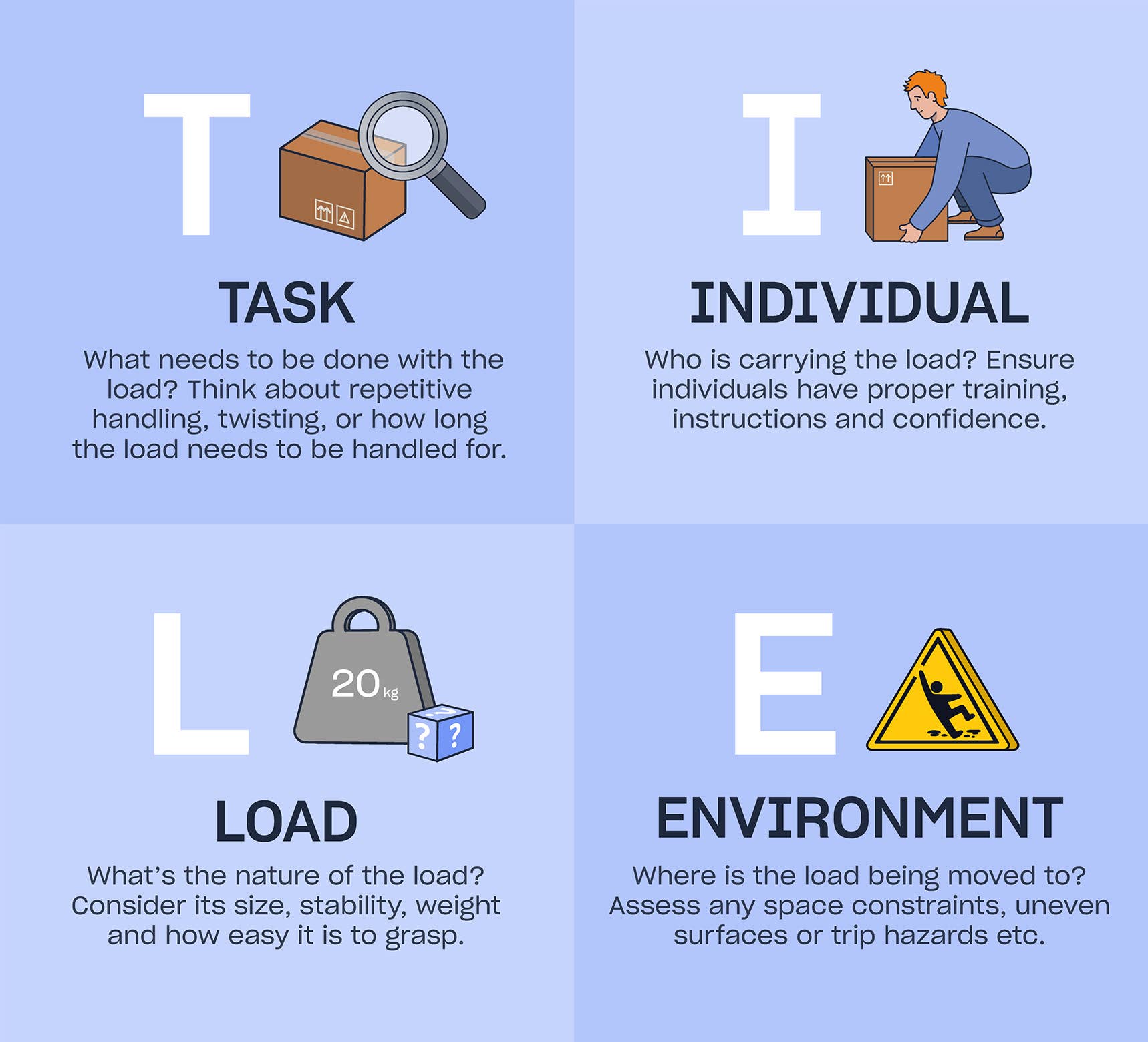
Carry out a suitable risk assessment – where hazardous manual handling cannot be avoided, employers should assess the risks involved. A manual handling risk assessment should consider the specific circumstances of the task, rather than simply assuming that a particular weight is safe or unsafe. Factors to consider in a risk assessment are often known as TILE:
- The task, including how often it is carried out, how far loads need to be moved and whether lifting, carrying, pushing or pulling is involved.
- The individual, including their physical capability, knowledge, training and any relevant health considerations.
- The load, including its weight, size, shape, stability and how easy it is to grip.
- The environment, including available space, flooring, lighting, temperature and whether there are obstacles or uneven surfaces.
Provide suitable equipment – the right equipment can significantly reduce the amount of physical effort required to move a load. Depending on the task, this could include trolleys, sack trucks, hoists, lifting tables or other mechanical aids. Equipment should be suitable for the task, readily available and properly maintained. Employees should also know how and when to use it.
Where mechanical aids can’t be used, changes to the task, load and working environment should be considered instead. This could include reducing the size or weight of a load, breaking large loads into smaller ones or reducing the distance a load needs to be carried.
Provide appropriate training – employees should receive suitable information and training so they understand the risks associated with the manual handling tasks they carry out and the control measures they need to follow. Training should be relevant to the person’s role and should help them understand how to work safely, rather than simply teaching them a single lifting technique. All employees should know how to identify hazardous tasks, use handling equipment correctly and report concerns or problems.
Create a safe working environment – the working environment can make manual handling safer or more difficult. Employers should consider whether workers have enough space to move safely and whether they can see where they are going while carrying a load. Where appropriate, improvements to the environment could include:
- Providing sufficient space for handling tasks.
- Keeping floors in good condition and free from obstructions.
- Improving lighting where visibility is poor.
- Reducing unnecessary carrying distances.
- Avoiding the need to lift from floor level or above shoulder height.
- Providing suitable storage so frequently handled items are within easy reach.
- Allowing enough time to complete tasks safely rather than encouraging employees to rush.
Use toolbox talks and ongoing communication – manual handling should be treated as an ongoing workplace safety issue, rather than something that is covered once during an employee’s induction. Toolbox talks can be useful for reminding workers about specific manual handling risks, discussing recent incidents or near misses and reinforcing safe systems of work. They can also provide an opportunity for employees to raise concerns about equipment, working conditions or tasks that they believe could be made safer.
Poor manual handling can have consequences ranging from minor strains and bruises to serious, long-term musculoskeletal disorders. It can also affect an employee’s wellbeing and create wider disruption for the workplace. With suitable equipment, a safe working environment, appropriate training and good communication, workplaces can help prevent avoidable manual handling injuries.
Further Resources:
- Manual Handling Awareness Training
- What Does TILE Stand For? TILE, LITE & TILEO Acronyms
- Manual Handling Risk Assessment: Free Template


Post Author

You may also like