

How to Administer CPR: Guidelines & Steps
 6 min read
Medical emergencies requiring CPR can happen at any time and place. The British Heart Foundation reports that there are over 30,000 out-of-hospital cardiac arrests (OHCA) a year where emergency medical services attempt to resuscitate the victim, and less than 1 in 10 people in the UK survive an OHCA. It’s important for everyone to have a basic knowledge of CPR as this may give you the ability to save someone’s life.
In this article, we explain what CPR is, why it is administered and who can give it. You will learn what steps you should take depending on whether you are administering CPR to an infant, child or adult. You will also be able to download the infographics that accompany the stages throughout.
- What is CPR?
- Why Do We Perform CPR?
- Who Can Administer CPR?
- When Do We Use CPR?
- How to Administer CPR on an Infant
- How to Administer CPR on a Child
- How to Administer CPR on an Adult
- How to Administer Hands-Only CPR for Adults
Use the contents above to jump to a certain section of the guide.
What is CPR?
CPR is short for cardiopulmonary resuscitation. It is a life-saving medical procedure that is carried out when someone has a cardiac arrest. A cardiac arrest is where a person’s heart suddenly stops pumping blood around their body. This then starves their brain of oxygen, causing the person to fall unconscious and stop breathing.
A person in cardiac arrest may display the following signs and symptoms:
- Either not breathing or aren’t breathing normally and making gasping sounds.
- Unconscious and aren’t moving.
- Unresponsive, such as to touch or sound.
If a casualty is unresponsive and not breathing normally or at all, it is essential that someone carries out CPR on them immediately.

Know When to Use CPR?
Our CPR Awareness training course will give you an awareness of how to recognise when someone needs CPR and how to administer it. If you want to further develop your first aid awareness, then you could also take a look at our online Workplace First Aid training course and online Paediatric First Aid training course.
Why Do We Perform CPR?
CPR is the manual application of chest compressions and ventilations to a casualty who needs oxygen. Administering CPR helps to circulate blood and oxygen around the person’s body, when their heart and lungs cannot. When giving CPR, you are essentially taking over the role of the casualty’s heart and lungs. This helps to prevent their life-threatening condition from worsening further, before emergency medical assistance arrives and takes over.
A cardiac arrest is a time-sensitive medical emergency. This means that the person’s condition can deteriorate quickly if it isn’t treated as soon as possible. For cardiac arrests that happen outside of hospitals, this means that workplace first aiders, bystanders and family members and friends may be the ones who are present and need to start CPR. In fact, figures by the London Ambulance Service NHS Trust show that around 70 percent of cardiac arrests take place in the home.
Taking action and giving CPR prevents a casualty’s condition from significantly worsening while they wait for emergency medical assistance. For many people, quick intervention may mean the difference between life and death.
Can Anyone Do CPR?
Before you attempt to administer CPR, you need to be confident in your understanding and be able to recognise when a casualty needs CPR. You must know what steps need to be taken depending on the age of the casualty and whether you have had practical first aid training.
It’s important to note that if you haven’t had practical training that qualifies you as a first aider, you should not give CPR with rescue breaths to adults. This means you should give hands-only CPR (just chest compressions) instead.
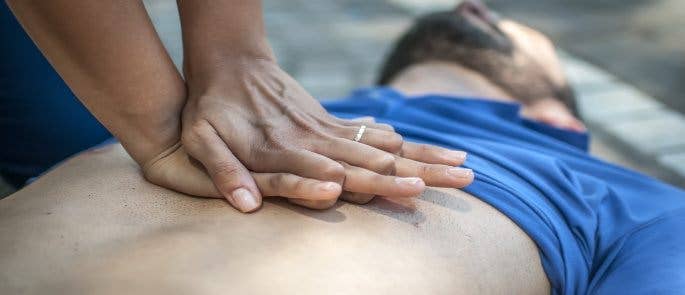
However, if a child or infant has a cardiac arrest, it is likely that this is due to a respiratory failure. As a result, you must perform rescue breaths on children and infants if you have had practical training and feel confident in doing so. If you have not had practical first aid training or are uncertain, you must get advice from the emergency services on the best course of action to take for the specific circumstances.
If you have any uncertainties about giving a casualty CPR at any time, you can speak to the emergency call handler on 999 or 112. The call handler is best placed to give you instruction on what to do in various situations.
When Do We Use CPR?
CPR should be performed on a casualty if they are unresponsive and not breathing normally (or at all). Someone may be unconscious, unresponsive and not breathing normally due to a number of factors. For example, someone may be drowning and require CPR once they have been rescued from the water. Or, they may be severely choking, severely bleeding, or experiencing shock.
If you find someone who has collapsed and is unresponsive and unconscious, you should carry out a primary survey using the DR ABCDE steps. This will help you to determine whether it is safe for you to approach the casualty and to quickly identify whether there’s an immediate threat to their life. It enables you to make an assessment of the situation and identify the casualty’s needs, including whether it is life-threatening and if you need to respond immediately.
During the primary survey, you should check whether a casualty is breathing normally. You can look for chest movements, listen for breathing sounds and feel for air from their mouth on your cheek for 10 seconds. If they are unresponsive but breathing normally, put them in the recovery position. If the casualty is unresponsive and not breathing normally, or at all, you must prepare to give them CPR.
You can find out more about performing the primary survey in our dedicated article, How to Carry Out the Primary Survey Using the DR ABCDE Steps.
How to Administer CPR to Infants
An infant is regarded as under the age of one year old. If an infant has a cardiac arrest, it is likely that this is due to a respiratory failure. As a result, you must perform rescue breaths if you have had practical training and feel confident in doing so. If you have not had practical first aid training or are uncertain, you must get advice from the emergency services on the best course of action to take for the specific circumstances.
To administer CPR to infants, you should:
- Ensure 999 or 112 have been called and placed on speakerphone. If you are alone and do not have a phone, give one minute of CPR before going to find help.
- Place the infant on a flat, firm surface and start CPR. Open their airway by placing one hand on their forehead and gently tilting their head back. Use a finger of your other hand to gently lift their chin.
- Place your lips around the infant’s mouth and nose and blow steadily for one second until their chest rises. Remove your mouth and wait for their chest to fall. Repeat this for a total of five initial rescue breaths.
- Give 30 chest compressions at a rate of 100 to 120 a minute. Encircle the infant’s chest with your fingers supporting the back, and place one thumb on top of the other on the lower half of the breastbone. Using your two thumbs, press down to a third of the depth of the chest. If you are unable to reach this depth, you may need to use the one-hand technique.
- Repeat the sequence of 30 compressions and two rescue breaths until emergency help arrives or the infant starts to breathe normally.
- If the infant begins breathing normally, put them in the recovery position. Continue to monitor their condition as you may need to give CPR again.
It’s important to note that automated external defibrillators (AEDs) should not be used on infants that are less than one year old.
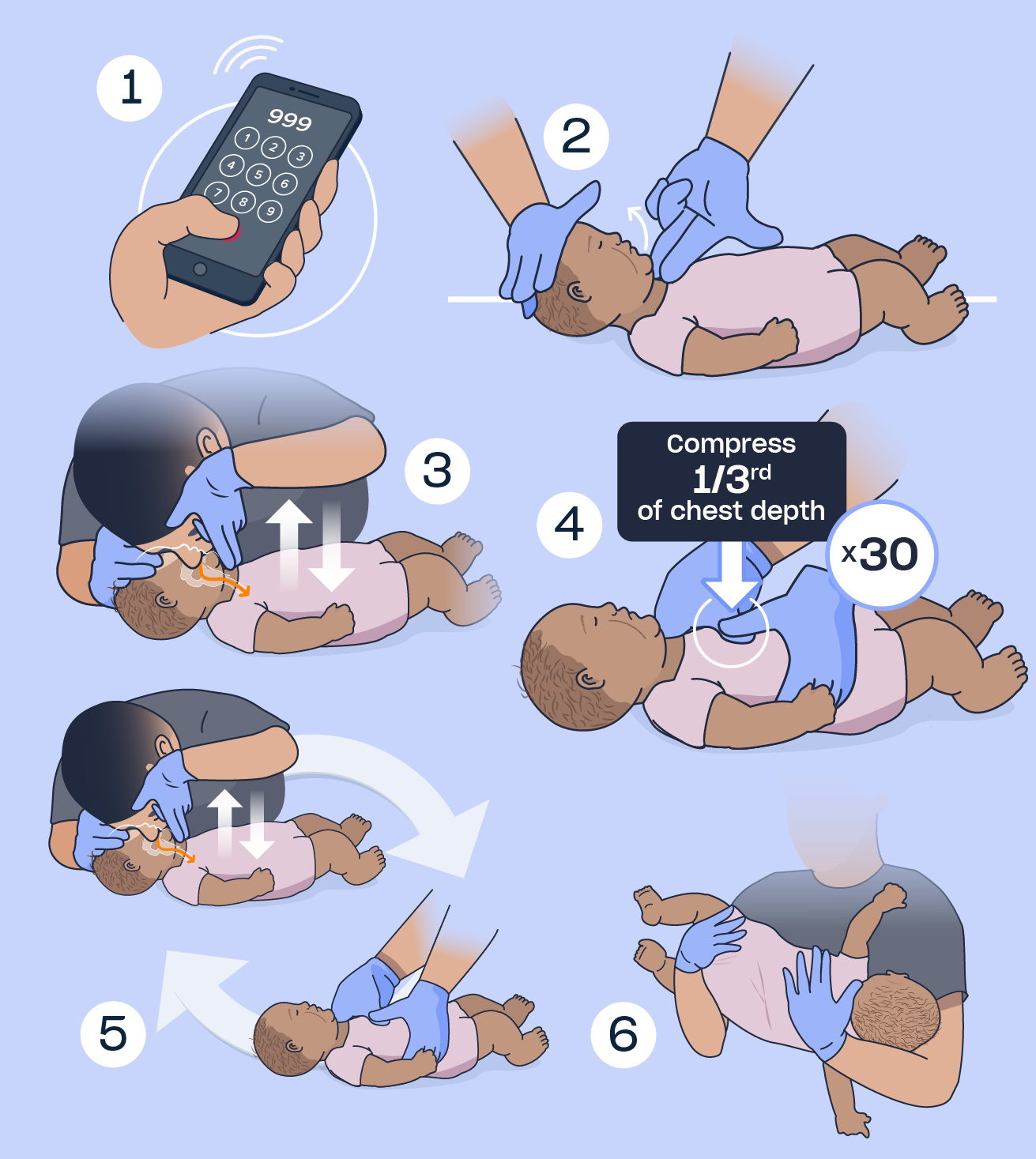
We have created a poster that shows the steps of administering CPR to infants. You may wish to print this out and display it in your workplace as a handy reminder of what to do if an infant is unresponsive and not breathing normally. The CPR steps for infants poster can be downloaded at the link below.
How to Administer CPR to Children
In first aid terms, a child is anyone from the age of one year old to the onset of puberty (usually around 12 years old). Like with infants, if a child has a cardiac arrest, it is likely due to a respiratory failure. Therefore, you must perform rescue breaths if you have had practical training and feel confident in doing so. If you have not had practical first aid training or are uncertain, you must get advice from the emergency services on the best course of action to take for the specific circumstances.
To administer CPR to children, you should:
- Ensure 999 or 112 have been called and placed on speakerphone. If you are alone and do not have a phone, give one minute of CPR before going to find help.
- Start CPR. Kneel next to the child and position them on their back. Gently open their airway by placing one hand on their forehead and tilting their head back, using the fingers of your other hand to lift their chin.
- Give five rescue breaths, using a face barrier if one is available. Keeping their head tilted, take the hand off the forehead and pinch their nose. Take a normal breath, seal your lips around the child’s mouth and blow steadily for about one second until their chest rises. Remove your mouth and watch their chest fall. Repeat for a total of five initial rescue breaths.
- Give 30 chest compressions at a rate of 100 to 120 a minute. Place the heel of one of your hands on the breastbone in the centre of their chest. With your arm straight, compress the chest to a third of its depth. If you can’t achieve that depth with one hand, use two as you would with an adult. Release the pressure and repeat 30 times followed by two rescue breaths.
- Repeat the sequence of 30 compressions and two rescue breaths until the child begins to breathe normally or emergency help or an AED arrives.
- Put the child into the recovery position if they start to breathe normally. Continue to monitor their condition as you may need to give CPR again.
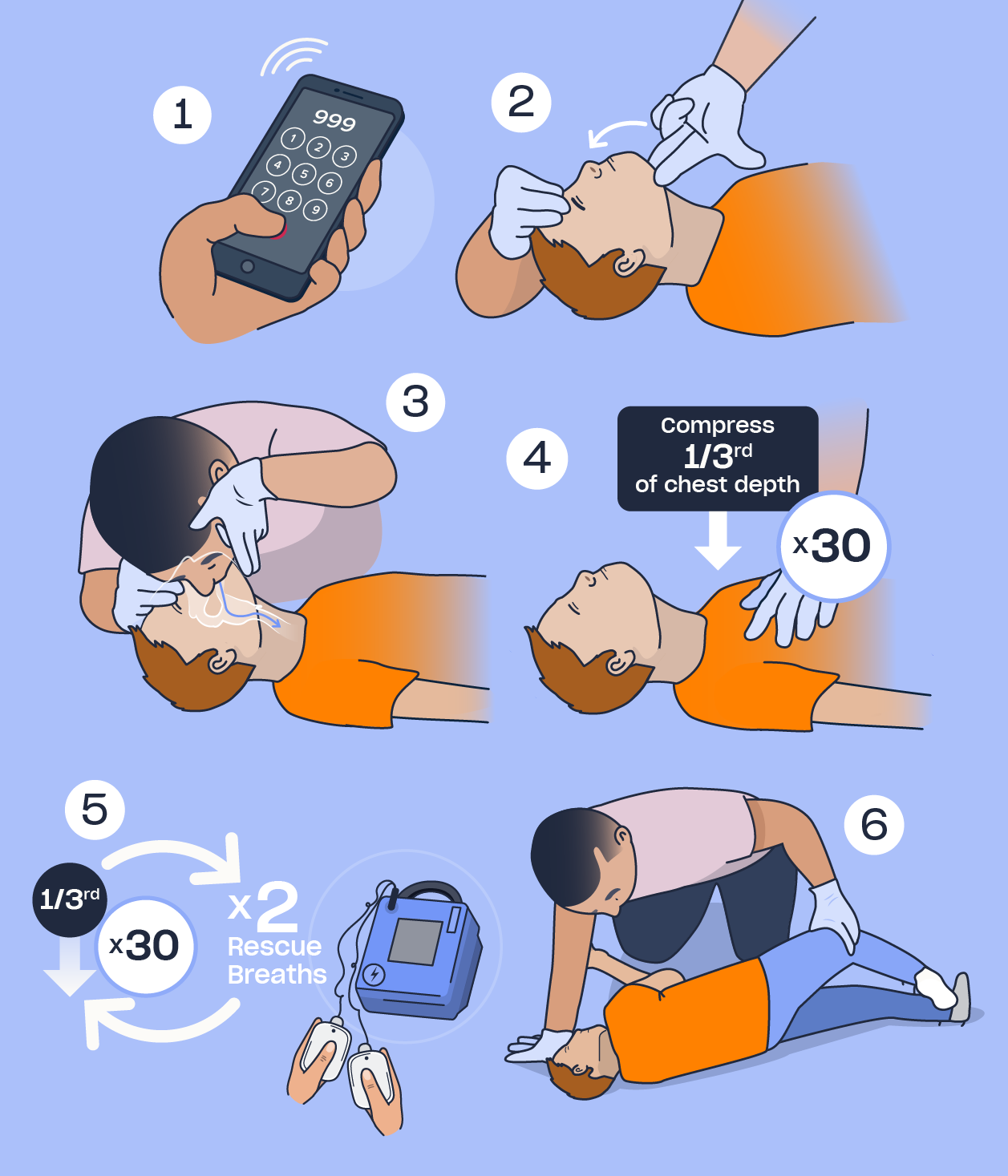
We have created a poster that shows the steps of administering CPR to children. The CPR steps for children poster can be downloaded at the link below.
How to Administer CPR with Rescue Breaths to Adults
In first aid terms, an adult is anyone from the onset of puberty (usually around 12 years old) and older. If you are a qualified first aider, meaning you have previously attended a practical and certified training course, and feel confident in using your skills, then you should give the adult casualty rescue breaths along with the chest compressions.
To do so, you should:
- Shout for help and make sure 999 or 112 have been called and placed on speakerphone before beginning CPR.
- Position the casualty on their back and kneel beside them.
- Place the heel of one of your hands on the breastbone in the centre of their chest. Place the other hand on top, interlocking the fingers. Lean over the casualty and with your arms straight, use your body weight to compress the chest to a third of its depth, then release.
- Repeat this 30 times at a rate of two per second, or in time with the song ‘Staying Alive’. This equates to 100 to 120 compressions a minute.
- Give two rescue breaths after 30 compressions. Tilt the casualty’s head and gently lift up their chin with two fingers. Pinch their nose, take a deep breath and seal your lips around their mouth. Blow deeply for about one second until you see their chest rise, remove your mouth and let the chest fall. Repeat this so they receive two rescue breaths.
- Repeat the sequence of 30 compressions and two rescue breaths until the casualty begins to breathe normally, emergency help arrives or an AED is ready to use.
- Put them into the recovery position if they start to breathe normally. Continue to monitor their condition as you may need to give CPR again.
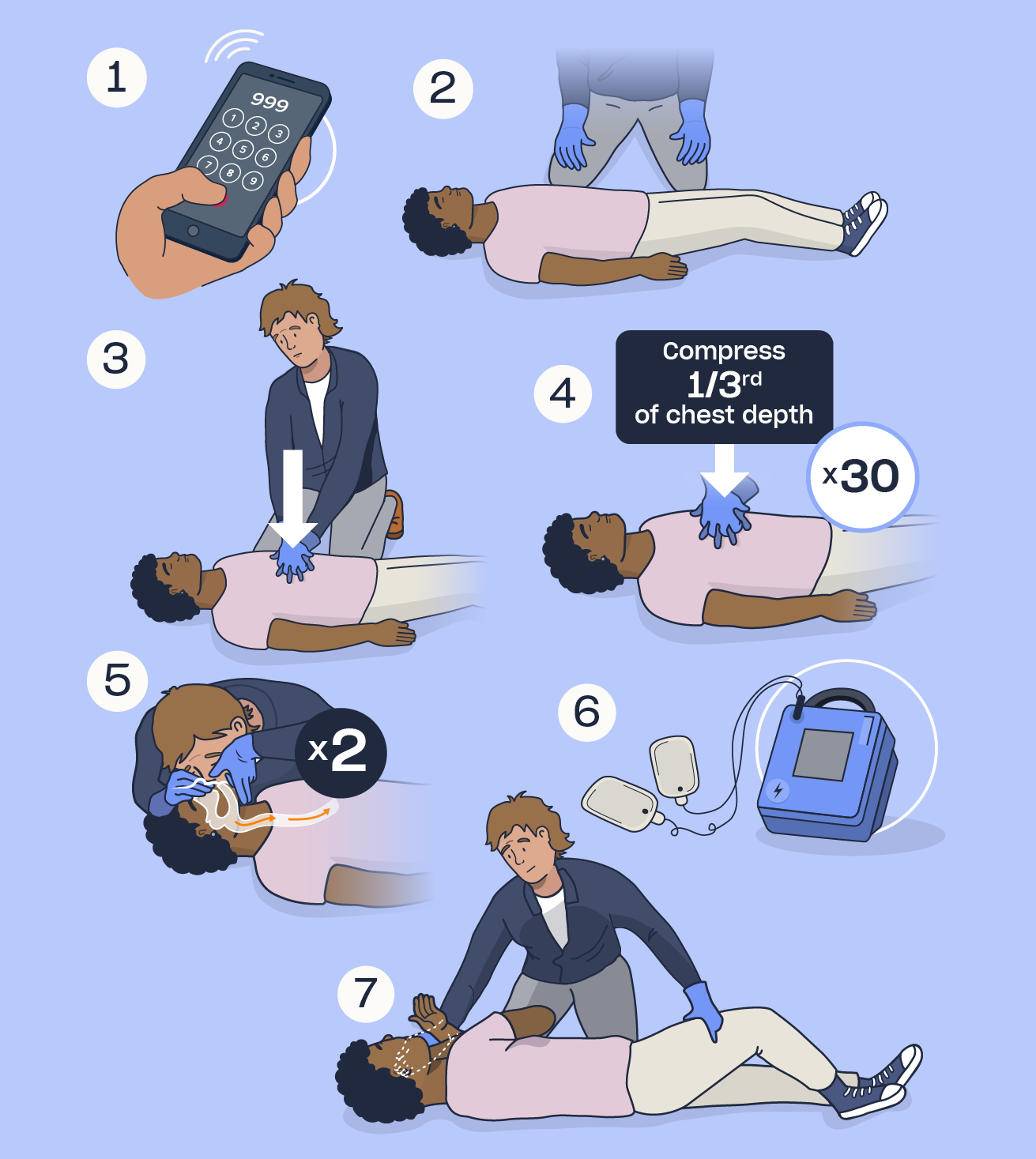
We have created a simple infographic that shows the steps of administering CPR with rescue breaths to adults. The CPR steps for adults infographic can be downloaded at the link below.
How to Administer Hands-Only CPR to Adults
If you aren’t a qualified first aider and haven’t had practical training, you should not give rescue breaths to adults during CPR. Instead, the NHS advises that you should only attempt the chest compressions.

To administer hands-only CPR to adults, you should follow the steps below.
- As soon as you determine the casualty is unresponsive, call 999 or 112 and place the call on speakerphone while you assess their airway and breathing. If they are not breathing normally, or at all, begin CPR. If someone else is nearby, you should ask them to fetch an AED if available. Do not go looking for one yourself, as your priority is to give CPR.
- Start CPR by kneeling next to the casualty’s chest and positioning them on their back.
- Straighten your arms and lean over the casualty, placing the heel of one of your hands on the breastbone at the centre of their chest. Place the heel of your second hand on top of the first, interlocking your fingers and making sure they don’t touch their ribs.
- Keep your arms straight and use your body weight to press directly down to a third of the depth of the chest. Release the pressure and allow the chest to rise back up. Give continuous compressions at a rate of two per second, or in time with the song ‘Staying Alive’.
- Repeat compressions at a rate of 100 to 120 times a minute until the emergency services arrive, the casualty starts to breathe normally, you become too exhausted to continue or if an AED is ready to be used. If you do become too exhausted to continue and there is another person present, they may be able to take over with chest compressions while you rest. To maintain high-quality compressions, it’s recommended to switch rescuers approximately every two minutes where possible.
Ensuring that someone who is unresponsive and not breathing normally is given CPR as soon as possible increases their chances of survival before the emergency services arrive. Therefore, it’s important for everyone to have an awareness of how to administer CPR, whether they are a qualified first aider or not. Although non-qualified first aiders should only give hands-only CPR to adults, and seek the advice of the call handler when giving CPR to children and infants, doing so will still increase the chances of the casualty surviving.
Further Resources:
- Workplace First Aid Training
- How to Do the Secondary Survey
- What are the Responsibilities of a First Aider?
- Guidance for First Aid Kits in the Workplace
- Paediatric First Aid Quiz
- Guidance on What To Do If Someone Is Choking
- CPR Awareness Training


Post Author