

Revision Timetable: Free Template
 6 min read
Exams are an inescapable but undeniably daunting part of school life. Whilst students may view study leave as a de facto holiday, it’s vital that they use this time effectively to revise and prepare for their exams. A revision timetable can help students to manage their time, focus on weaker areas and schedule necessary breaks for rest and relaxation. In this article we will outline what a revision timetable is and how it can support students during their exams. We will also provide you with a free downloadable template that you can use to help students create their own timetable.
What is a Revision Timetable?
A revision timetable is an essential time management tool that helps students to manage their studies and prepare for exams. Much in the way that a school timetable gives structure to a student’s day, a revision timetable allows a student to better structure their revision.
Preparing for exams can be incredibly overwhelming and having an extensive amount of time off school to study can sometimes exacerbate these feelings. A school routine provides a structure that helps students to break their studies down into manageable chunks. When this routine is removed, students can struggle to concentrate, know where to begin or where to end a day of revision. Therefore, a revision timetable provides a personalised structure that allows a student to approach their revision in a more manageable and efficient way.

Revision timetables are beneficial because they:
- Are flexible – Revision timetables aren’t set in stone and unlike a school schedule they can be adapted to suit an individual student’s needs. For example, if a student is revising for their upcoming History exam and they recognise that there are notable gaps in their knowledge on a particular period of time, they may choose to rearrange their timetable to allow more time for that module. Comparatively, if a student is revising and realises they have a greater understanding of a particular subject than they thought, they can adjust their timetable so that the amount of time that they spend on that subject reflects this strong knowledge.
- Can reduce exam stress – Revision timetables allow students to see what they need to study and when. This can help to make exams as a whole feel less daunting as they have a better awareness of the work that needs to be done for each subject. Moreover, as a student continues to use their revision timetable they will hopefully see that their planning and preparation has been worthwhile, giving them confidence when it comes to the exam.
- Allow for better focus – Approaching one subject at a time enables a student to better identify their strengths and weaknesses. They can then tailor their revision to focus on gaps they need to fill rather than going over topics they are confident with purely for the sake of it.
- Reduce the risk of cramming – Revision timetables allow better time management. This helps students to use their time effectively and schedule in rest time, rather than spending days doing nothing and then cramming for hours on end a few days before the exam. A well structured revision timetable allows a student to approach their work in manageable sections, promoting better retention and less ineffective and stress inducing cramming.
How to Make a Revision Timetable
In order to be effective a revision timetable must be suited to the individual student. Whilst they can follow the same general structure, it’s vital that they are tailored to the particular needs of a student so as to reflect their work load, their subjects and their capacity.
When creating a revision timetable it can be helpful to model it on a regular school day as this is a structure that students will be used to. The familiarity of this structure should also help students to maintain their concentration throughout the day. Following the school timetable also ensures that breaks are accounted for and that students don’t spend an excessive amount of time on one subject.

It’s important to remember that there is no set way to revise and each individual student will revise in different ways. As such, whether you are a teacher, parent or carer, when helping a student to create a revision timetable it’s important to listen to how they revise and to factor this into any planning. For example, if a student mentions that they prefer to go over their notes and then reduce them to key points which they write onto flashcards, designing a schedule that focuses on mock exams for each subject or topic will be ineffective.
When supporting a student to create a revision timetable your guidance is important, especially as they may inadvertently avoid topics that they feel less confident with. Nevertheless, the timetable must reflect how a student wants to approach their studies as they are most likely to stick with and follow a timetable that recognises their approach to studying.
To make a revision timetable:
- Decide how much time in the day should be spent revising – As mentioned, modelling a timetable on a school day can help ensure that revision stays achievable. This could mean starting at 9am and finishing at 3pm with an hour break in between or exploring variations thereupon. Whilst this may not seem like much, spread across a week this can add up to significant time spent on each subject whilst remaining manageable and undaunting. Depending on the student and their capabilities it may be necessary to spend longer revising each day. It’s advisable to approach this in an ad hoc manner to avoid overbearing the student and reinforcing the notion that every waking moment should be spent studying.
- Identify stronger/weaker subjects – It can be easy to fall into the trap of spending an equal amount of time on each subject, or comparatively, spending an excessive amount of time on one subject due to it being harder. However, taking the time to identify which subjects are stronger/weaker ensures that a student can better prioritise how much time they wish to spend on each one. For example, a student that struggles with English but excels in maths may decide to spend more time focusing on their English. This may seem like a sensible choice, but in doing so they leave next to no time to uphold their maths skills which leads to cramming and stress. Identifying which subjects a student is strongest or weakest in allows for better planning so that weaker subjects get the necessary time but not at the expense of stronger subjects.
- Organise revision – A revision timetable that simply states ‘History @ 2pm’ isn’t helpful. An important part of creating a revision timetable is identifying what needs to be studied and how. This doesn’t necessarily need to be written in the timetable and can be a separate document. Nevertheless, knowing how each subject is going to be revised and what that revision encompasses ensures that a timetable provides useful and effective guidance. For example, a student may decide to keep the same revision timetable throughout the duration of their study leave, studying the same subject at the same time each week. However, at the start of each week they may decide how they are going to revise for each subject and what particular topics. This may encompass focusing on a specific time period in History, reading over notes for and condensing them for Religious Studies or taking a mock test for maths.
- Mix things up – Interleaving is a method of revision in which students go through different topics rather than focusing solely on one topic for a block of time and then not revisiting it until the exam. Studies have shown that interleaving can strengthen memory and help to keep the brain continuously engaged. Interleaving doesn’t necessarily mean studying multiple different subjects a day and can instead involve looking at different topics within the same subject to create a better feeling of overall understanding.

Free Revision Timetable Template
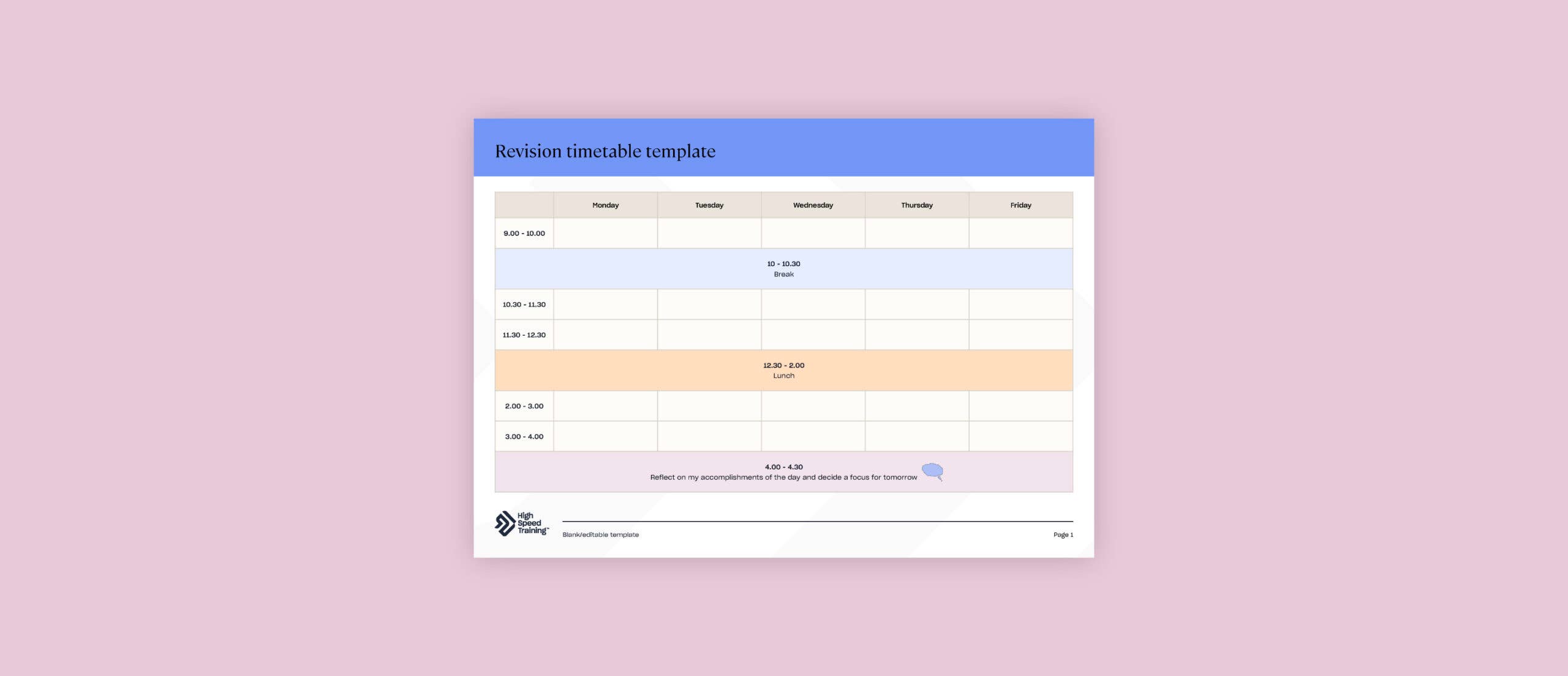
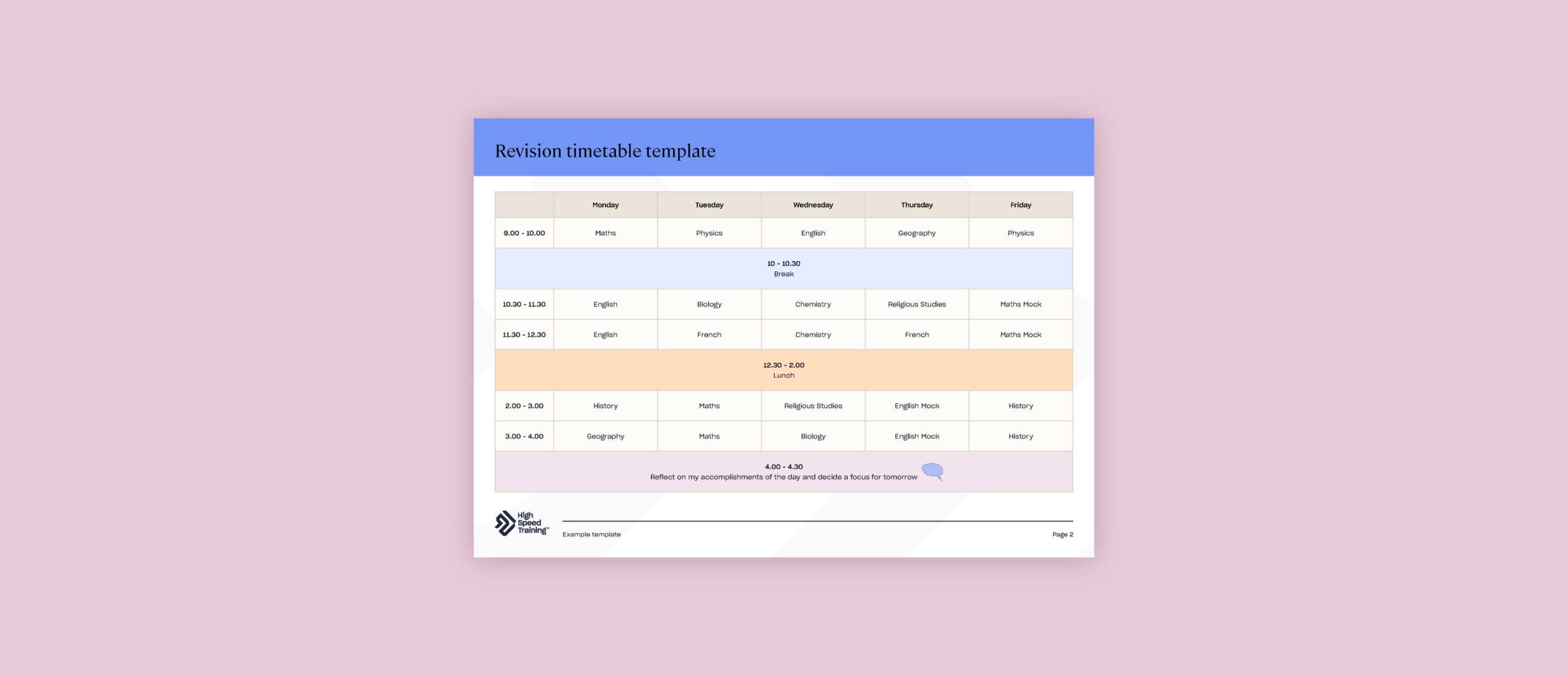
Below you will find a free revision timetable template that you can download and adapt to the needs of your students. As mentioned, it’s vital that revision timetables suit the needs of an individual student. It can therefore be helpful to support a student when filling out their timetable to ensure it is realistic and reflects their needs, not the needs of their peers. You will also find below an example revision timetable that has been filled out for a GCSE student. The example template gives you an idea of how subjects can be spread across the week and how a timetable can be adapted to suit the strengths and weaknesses of a student.
The template below includes breaks and preparation time at the end of each day so that a student can reflect on what they have accomplished that day and what their focus will need to be going forward. As mentioned above, it can be helpful when organising revision to decide what is going to be revised and how. Therefore, the reflection period at the end of each day is a useful period of time in which a student can do this and encourages adaptation depending on what they have or haven’t achieved that day.
Following the school timetable can make revision feel less daunting and more achievable for a student. As such, the template does not include the weekend and keeps those as designated rest days. Rest is vital during revision and there is only so much information that one can absorb before burning out. Prioritising rest and ensuring that time is actively made for it can help to stop revision feeling overwhelming and all consuming.
Revision timetables are helpful time management tools that can take the stress out of exam preparation. When used effectively and created to reflect the needs of an individual student, they can make revision feel less daunting and provide a useful and familiar structure to revision that ensures students stick to it.
Further Resources:
- What is Exam Stress?: Tips for Parents and Teachers
- Could students really use AI to cheat in their exams? We put it to the test!
- CPD Courses for Teaching and Education




Post Author

You may also like