

School Food Standards: Free Poster
 8 min read
Growing minds and bodies need nutritious food to support their physical and cognitive development. Whether at home or at school, children need healthy food to provide them with the essential energy to grow and learn. The school food standards are a set of legal requirements for state schools in England that help to ensure that school meals are healthy and nutritious. Those who are involved in catering for pupils must have a solid understanding of these standards so that they can be legally compliant and provide healthy and nutritious food. In this article we will explain what the school food standards are, outline the proposed 2027 changes and provide guidance on how to prepare for these changes. We will also provide free downloadable posters that showcase the new and updated standards.
What are the School Food Standards?
The school food standards are a set of legal requirements for state-funded schools in England. They establish standards that apply to the food and drink that is provided to pupils on school premises. The school food standards were designed to help children develop healthy eating habits and to ensure that the food they eat at school provides them with sufficient energy to get the most out of their school day. Independent schools are not legally required to comply with the standards but many independent schools do so voluntary as best practice.
The current school food standards came into force on 1st January 2015 and they were introduced in the Requirements for School Food Regulations 2014. These requirements reaffirm that eating in school should be a pleasurable experience during which children can share good food with their peers and teachers. It’s important to note that the school food standards are intended to support healthy eating and highlight the importance of good nutrition; they are not a set of punitive practices that seek to limit a child’s enjoyment of food.

Compliance with the school food standards is a legal requirement for state-funded schools. However, it’s important to recognise that the standards go beyond just ‘legal necessities.’ The school food standards enable schools to provide students with healthy and nutritious food whilst teaching them about the importance and benefits of a balanced diet. Moreover, the standards ensure that children have enough energy to support their learning throughout the school day, helping them to make the most out of their education.
School Food Standards 2027
Subject to Parliamentary approval, changes will be introduced to the school food standards that will come into effect from September 2027. These changes will reflect the latest government dietary recommendations by introducing more fresh fruit, vegetables and fibre-rich foods. Education Secretary Lucy Powell has hailed the changes as ‘once-in-a-generation,’ noting that they will ‘transform school food for children across the country.’
The proposed changes will:
- Increase the amount of fibre, fruit and vegetables offered.
- Reduce foods and drinks high in fat, sugar and salt.
- Introduce new breakfast standards.
The revised standards, which may be subjected to change, are as follows:
Starchy food 

- 1 or more portions of food from this group every day across all main items whenever served.
- 3 or more different starchy foods each week.
- All pasta dishes served on at least one day each week must contain at least 50% wholewheat pasta.
- Bread must be available every day.
- All breads to be at least 4g fibre/100g (or at least 50% wholemeal flour) and no more than 5g fat/100g. Crumpets, pizza bases and tea cakes are excluded from meeting the fibre requirement.
- Starchy foods that are cooked using fat or oil (including flash fried or coated in oil at manufacture) may be served on no more than 2 meal occasions per week, and only when they form part of a meal.
- When served simultaneously, meat and vegetarian dishes containing starchy carbohydrates cooked using fat or oil count once.
Fruit and vegetables
- All starters and desserts to be accompanied by, or contain, one or more portions of fruit or vegetables.
- Fruit and/or vegetables must be available in all school food outlets. At least 3 different fruits and vegetables each week.
- One or more portions of vegetables or salad must be included as part of all main items every day whenever served. Vegetables do not include pureed vegetables, potatoes, canned pasta in tomato sauce, baked beans, pulses served as a protein.
- Vegetables that are added to dishes can only count as a portion if the vegetables added amount to a full portion.
Dairy and plant-based versions
- A portion of food from this group every day.
- Plain unsweetened and unflavoured semi-skimmed, skimmed, 1% or lactose-free milk must be available for drinking at least once a day during school hours. In addition, plain soya, oat and pea drinks can be served, provided they are unflavoured, unsweetened or contain no sugar, and are fortified with calcium, iodine, vitamin D, riboflavin and vitamin B12.
- Whole milk may be provided for pupils up to the end of the school year in which they attain the age of 5.
- Dairy yoghurt, fromage frais, custard and rice pudding must contain less than 10g total sugar per 100g and must not contain sweeteners.
- Plant-based versions must contain less than 7g total sugar per 100g, must not contain sweeteners, and must be fortified with calcium, iodine, vitamin D, riboflavin and vitamin B12.
- Primary schools: No more than 2 portions of food that includes cheese may be served each week.
- Secondary schools until September 2028: No more than 3 portions of food that includes cheese each week. From September 2028, the maximum serving of cheese will reduce to 2 portions a week.
- These limits apply to all main items whenever served and include plant-based versions (that must be fortified with calcium). This excludes cheese as an optional topping for jacket potato and pasta. Where meat and vegetarian dishes containing cheese are served at the same time, they count as one meal occasion.
Proteins: meat, fish, eggs, pulses and other proteins
- A?portion?of food from this group every day, across all main items whenever served.?
- A?portion?of meat, poultry, or pulses on 3 or more days each week (including beans, lentils, chickpeas. Does not include baked beans). At least 1 vegetarian main item must include a portion of pulses on 3 days a week.??
- In meat/fish serving schools, oily fish to be served at least once every 3 weeks.
- No more than 2 portions a week of manufactured meat and fish alternative products. Excludes plain mycoprotein, tofu, soya and tempeh, in the form of mince, chunks, pieces.??
- At least once a week a?portion?of pulses should be included within or alongside all main items (including beans, lentils, chickpeas. Does not include baked beans).
- Secondary schools until September 2028: At least once every 2 weeks a?portion?of pulses should be included within or alongside all main items (including beans, lentils,
- chickpeas. Does not include baked beans). From September 2028, this requirement will change to at least once a week for secondary schools.
- Cheese and baked beans added?to the protein food group.
Foods higher in saturated fat, sugar and salt
- No more than a total of 2 portions of food from this group across the week. Includes all main items whenever served:
- Batter-coated or breadcrumb-coated
- Food including pastry (includes sweet/savoury pastry items)
- Processed meat, meat and poultry products.
- Food from any one of these groups cannot be served more than once per week. Where meat and vegetarian versions are served at the same time, they count as one meal occasion.
- Secondary schools: processed meat may be served only once per week, either at breakfast or during the school day, but not both. Any processed meat served at breakfast counts towards the weekly maximum of one portion.
- No deep-frying in preparation of the final dish.
- No snacks in primary and secondary schools except:
- plain fruit and vegetables (does not include juice, smoothies and purees, dried fruit and processed or extruded fruit products)
- plain savoury crackers and breadsticks
- yoghurt and plant-based versions that meet the requirements of the dairy and plant-based versions food group
- houmous
- No confectionery, sweets, chocolate, chocolate coated products, chocolate containing products, chocolate spreads. Except for cocoa powder (includes?cereal bars,?processed or extruded fruit products).
- Salt must not be available to add to food after it has been cooked.
- Any condiments and sauces must be limited to sachets or portions of no more than 10g or one teaspoonful. These must be reduced sugar, salt and/or fat and no sweeteners.
- Reduced sugar jams and marmalades must be limited to sachets or portions of no more than 10g or one teaspoonful.
- Savoury spreads must be limited to sachets or portions of no more than 10g or one teaspoonful.
- Chocolate spreads, honey, syrups and other sweet spreads are not permitted.
- Foods and drinks containing no and low-calorie sweeteners must not be served in primary school.
- Foods containing no and low-calorie sweeteners must not be served in secondary school.
- Sugar, honey, syrups and sweeteners must not be available to add to food or drinks after cooking/preparation.
- Primary schools: No more than 1 portion of sweetened baked products and desserts (manufactured or homemade) can be served each week. Fruit or vegetables must be contained within the dessert and where this does not equate to a portion (40g), it should be accompanied with additional fruit or vegetables to make up the full portion.
- Secondary schools: No more than 2 portions of sweetened baked products and desserts (manufactured or homemade) can be served each week. Fruit or vegetables must be contained within the dessert and where this does not equate to a portion (80g), it should be accompanied with additional fruit or vegetables to make up the full portion.
Drinks
Primary Schools:
Free, fresh drinking water?at all times?and must be available in the dining room/where food is served.
For primary schools, the only drinks permitted are:?
- Plain unsweetened and unflavoured water (still or carbonated)??
- Plain unsweetened and unflavoured semi skimmed, skimmed, 1% or lactose free milk
- Plain unsweetened and unflavoured fermented milk (such as yoghurt) drinks
- Plain soya, oat and pea drinks. Must be unflavoured and unsweetened or no sugar and fortified with each of these micronutrients: calcium, iodine, vitamin D, riboflavin, vitamin B12
Secondary Schools:
Free, fresh drinking water?at all times?and must be available in the dining room/where food is served.?
For secondary schools, from September 2028 the only drinks permitted are:
- Plain unsweetened and unflavoured water (still or carbonated)?
- Flavoured water that is sugar free (still only)?
- Fruit-flavoured still drinks with no added sugar and a maximum of 0.5g total sugar per 100ml as diluted (can include sweeteners)?
- Plain unsweetened and unflavoured semi skimmed, skimmed, 1% or lactose free milk?
- Plain unsweetened and unflavoured fermented milk (such as yoghurt) drinks
- Plain soya, oat and pea drinks. Must be unflavoured, unsweetened or no sugar and fortified with each of these micronutrients: calcium, iodine vitamin D, riboflavin, vitamin B12
- Tea, coffee, without additions such as syrups, sprinkles and cream.
This change will be phased in for secondary schools, which may continue to follow the 2014 drinks standards until September 2028.
Two new standards will also be introduced in the 2027 changes. These are:
Meal deals
A new standard to improve the nutrition of meal deals and ensure meal deals provide the same fruit and vegetables content as items offered as part of the main menu.
- A meal deal must include at least 1 portion of vegetables/salad and at least 1 portion of fruit.
- Meal deals can include drinks from the permitted drinks list.
Breakfast standards
Introducing breakfast standards will help to ensure a healthy, balanced offer at breakfast that is in line with the rest of the school day. A starchy carbohydrate must form the basis of the breakfast offer. While the existing standards apply across the whole school day, including breakfast, there are no specific standards for breakfast provision.
- Breakfast cereals:
-
- Cereals permitted at breakfast are:
- Cereals with a maximum of 5.5g/100g total sugar
- No added sugar muesli
- Plain unflavoured porridge
- Cereals permitted at breakfast are:
- Breads and bakery goods:
-
- All breads to be at least 4g fibre/100g (or at least 50% wholemeal flour), and no more than 5g fat/100g.
- On 2 days a week, one of the following bakery goods can be served:
- Teacakes
- Crumpets
- Unsweetened pancakes
Crumpets, teacakes and unsweetened pancakes are excluded from meeting the fibre requirement of containing at least 4g fibre/100g or at least 50% wholemeal flour.
- Fruits and vegetables:
-
- A portion of fruit or vegetables must be available at breakfast.
- This can be fresh, dried, canned in juice (not in syrup), defrosted from frozen, or cooked.
- Fruit does not include fruit juice, smoothies and fruit purees.
- Vegetables do not include potatoes, canned pasta in tomato sauce or baked beans.
- Dairy and plant-based versions:
-
- Plain unsweetened and unflavoured semi skimmed, skimmed, 1% or lactose free milk.
- Plain soya, pea and oat drinks. Must be unflavoured, unsweetened or no sugar and fortified with each of these micronutrients: calcium, iodine, vitamin D, riboflavin, vitamin B12.
- Dairy yoghurt to be less than 10g/100g total sugar and not contain non-sugar sweeteners.
- Plant based versions to be less than 7g/100g total sugar, not contain non-sugar sweeteners, and are fortified with each of these micronutrients: calcium, iodine, vitamin D, riboflavin and vitamin B12.
- Cream cheese permitted at a maximum of twice a week.
- Proteins:
-
- Eggs (not fried).
- Baked beans.
- Pulses.
- Meat alternative products, (such as vegetarian sausages) once a week.
- Secondary schools: Processed meat from specified products list can be served once a week. Processed meat may be served only once per week, either at breakfast or during the school day, but not both. Any processed meat served at breakfast counts towards the weekly maximum of one portion.
- Spreads:
-
- Reduced sugar jams and marmalades must be limited to sachets or portions of no more than 10g or one teaspoonful.
- Savoury spread must be limited to sachets or portions of no more than 10g or one teaspoonful.
- Chocolate spreads are not permitted.
- Sugar and no and low-calorie sweeteners:
-
- Sugar, honey, syrups and non-sugar sweeteners must not be available to add to food or drinks after cooking or preparation.
- Foods and drinks containing no and low-calorie sweeteners must not be served in primary school.
- Foods containing no and low-calorie sweeteners must not be served in secondary school.
- Drinks
-
- Free, fresh drinking water at all times and must be available where food is served.
- The only drinks permitted are those listed in the school food standards for the whole school day.
It is vital that schools read the standards in full so that they fully understand the new expectations and can prepare accordingly. Moreover, direct guidance from the Department for Education (DfE) provides additional information such as glossary of terms and meanings specific to the standards.
Subject to Parliamentary approval these changes will come into force in September 2027 with legislation expected to be published later in the autumn term. This article will be updated once further government guidance has been published.
How to Prepare for the 2027 Changes
The new standards will not come into force until September 2027, giving schools time to prepare for the proposed changes. Whilst the new standards do make notable changes in order to provide children with more nutrition, they do not represent a complete overhaul of the current standards. Nevertheless, it is beneficial for schools to prepare as far in advance as possible.
To prepare for the proposed changes the DfE suggests that schools:
- Review the proposed changes to the school food standards, as described in annex A of the School Food Standards: updating the legislative framework consultation.
- Discuss the changes with their catering provider.
- Review existing menus, contracts and procurement arrangements to identify any changes that may be needed.
- Plan to appoint a lead governor for school food from September 2027.
- Prepare to publish their school food policy and menus on their website from September 2027.
- Keep up-to-date with further guidance and legislative developments.

School Food Standards Poster
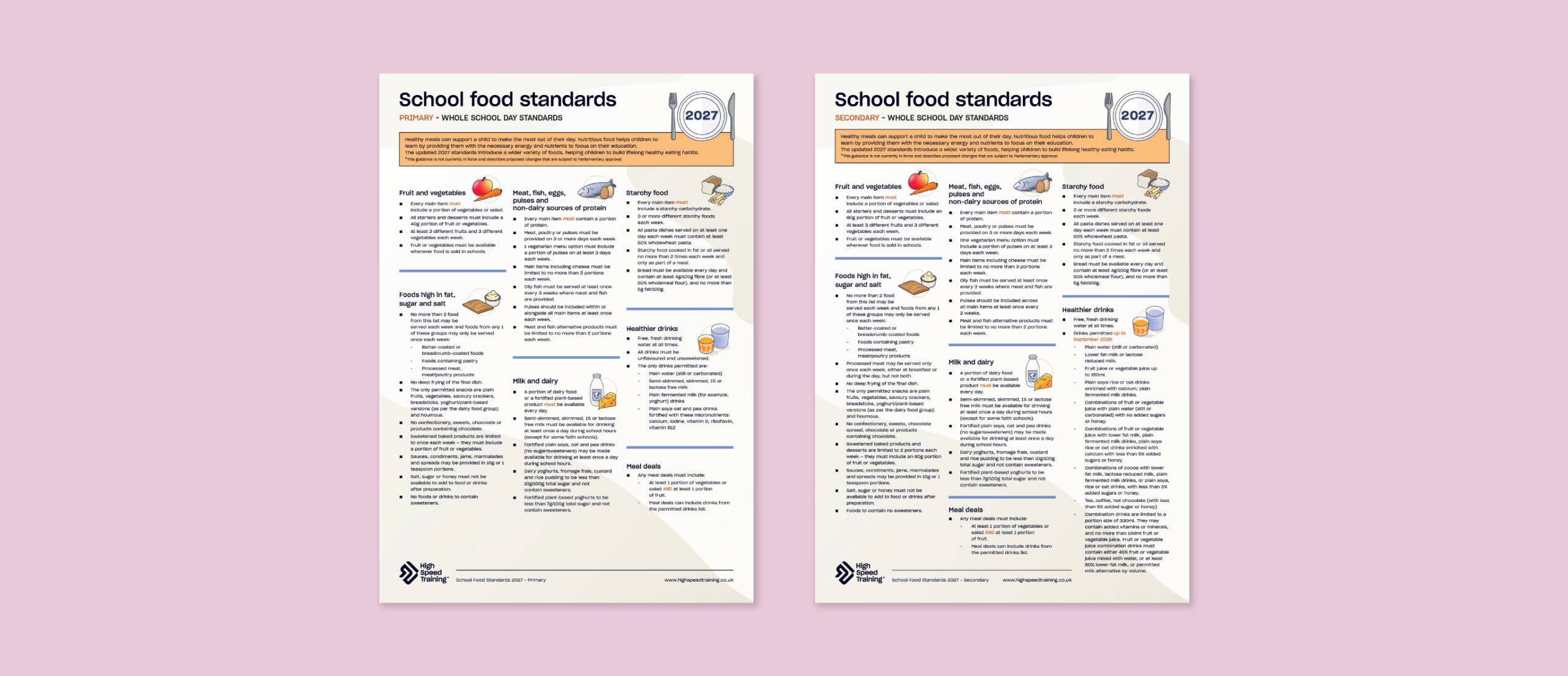
Below you will find two free downloadable posters to support you in complying with the new school food standards. These posters can help staff and catering providers with meal planning by ensuring that the necessary requirements are met for each food category. In so doing, school leadership can remain confident that they are providing a healthy and varied selection of foods that meet the necessary standards. The posters could also be used as a checklist when menu planning to ensure that each standard has been adequately met.
Due to the different age groups there are slight differences in the standards for primary schools and for secondary schools. As such, we have created two posters, one for primary schools and one for secondary schools.
Finally, as mentioned above, the 2027 changes are subject to Parliamentary approval and so may change. The information contained within the posters reflect the DfE guidance on proposed changes.
The school food standards are a set of requirements that ensure children are provided with healthy and nutritious food whilst at school. Compliance with these requirements goes beyond a legal necessity as they encourage children to develop lifelong healthy eating habits whilst ensuring they have the energy to make the most out of their school day. The proposed ‘once-in-a-generation’ changes will further support this by increasing access to nutritional, fibre-rich food thereby providing the next generation of children with beneficial and enjoyable meals.
Further Resources:
- Online Food Hygiene Training Courses
- What are the Food Hygiene Requirements in a School?
- What is a School Breakfast Club?
- How to Spot Allergy Bullying




Post Author

You may also like