

Workplace Pregnancy Risk Assessment: Health and Safety Guidance
 7 min read
Whilst pregnancy does not typically prevent people from working, it is important to be aware of the potential risks associated with working while pregnant. There are laws in place to help protect pregnant women and new mothers from risks to their health and safety and managers have a responsibility to uphold these laws and provide a safe working environment.
In this article we will explain what a pregnancy risk assessment is and why they are so important. We will also explore pregnancy rights at work and provide a free pregnancy at work risk assessment template.
What is a Pregnancy Risk Assessment?
A pregnancy risk assessment is a risk assessment that examines the health and safety conditions of the workplace for a pregnant employee or new mother. The assessment is intended to identify and control any risks and ensure that the necessary measures are put in place to provide a safe working environment.
Once an employee learns that they are pregnant, they must inform their employer, in writing, no later than the 15th week before their baby is due. Employers then have a legal duty to conduct a risk assessment. Conducting a workplace risk assessment for a pregnant employee is crucial to ensure their health and safety at work. It’s important to note that this risk assessment also applies to women who have become mothers within the last six months and women who are breastfeeding.
The risk assessment process should involve the pregnant employee/new mother, management and any recommendations given by a doctor or midwife. Pregnant employees and new mothers must be involved in the process so that they can highlight any individual concerns.

Workplace Pregnancy Rights and Laws
Pregnant employees and new mothers have a number of legal rights that protect their health and safety. Employers have a legal duty to ensure the health and safety of all their employees and this encompasses pregnant employees and new mothers. As such, employers must take all reasonable steps to remove or minimise any risks to a pregnant employee or new mother. If this is not possible an employer should arrange suitable alternative work. If alternative work cannot be found then the employee should be suspended on full pay for as long as necessary.
The key legislations that protects pregnant employees and new mothers are:
The Management of Health and Safety at Work Regulations 1999 

Under regulations 16 to 18, employers are required to manage the risks to pregnant employees and new mothers. Employers must also follow advice around night working and if it will affect the health of pregnant employees. In addition, it explains the employer’s legal duties once they are notified that an employee is pregnant, is breastfeeding or has given birth within the last six months.
The Employment Rights Act 1996
Under section 67, suitable alternative work should be offered to a pregnant employee if available, on the same terms and conditions, before suspension from work is considered. The Act also offers pregnant employees and some new parents special protection in a redundancy situation. The redundancy protected period is the length of time an employee has redundancy protection and it starts when the redundancy notice has been given. In April 2024 the protection period was extended and now starts when an employee tells their employer they are pregnant and ends 18 months from the exact date the baby is born.
The Workplace (Health, Safety and Welfare) Regulations 1992
Under regulation 25, employers are required to provide a suitable place to rest for employees who are pregnant, breastfeeding or new mothers.
The Equality Act 2010
Under this Act, employers cannot dismiss or discriminate against an employee because they are pregnant, a new mother, on maternity leave or breastfeeding. The Act requires no length of service qualification. The Act also protects people from discrimination during the ‘protected period.’ The protect period starts when someone becomes pregnant and usually ends when one of the following happens:
- their maternity leave ends
- they return to work
- they leave their job
Employment Rights Act 2025
This Act introduced additions and amendments to existing legislation including the Employment Rights Act 1996. It became law in December 2025 and changes included within the Act will take place over a period of two years with most changes happening in 2026 and 2027. The Act strengthens protections against dismissal for pregnant workers and those returning from maternity leave. These protections will come into effect in 2027.
As well as the specific protections mentioned above, pregnant employees have four main legal rights. These are:
- Paid time off for antenatal care
- Maternity leave
- Maternity pay or maternity allowance
- Protection against unfair treatment, discrimination or dismissal
Health and Safety Risks for Pregnant Women at Work
There are many health and safety risks for pregnant employees or new mothers. Whilst some workplace risks can become more dangerous to a pregnant woman or new mother, other risks may arise from an employee becoming pregnant. For example, pregnant women can experience an array of symptoms during pregnancy that can pose risks to their overall health and safety. These include:
- Reduced agility, speed, reach or balance
- Fatigue and exhaustion
- Stress and high blood pressure
- Severe morning sickness
These symptoms can become exacerbated in the workplace or increase the potential of harm.
Below you will find a list of some of the common potential risks to a pregnant employee and/or their unborn child. This list is not exhaustive and employers must consider the specific risks of their individual environment.
Potential risks to a pregnant employee include:
Posture and position – Postural problems can occur at any stage during the pregnancy and some may not become apparent until after giving birth. Employees should make sure that pregnant workers and new mothers are not:
- sitting or standing for long periods
- lifting or carrying heavy loads
- using a workstation that causes posture issues

Working conditions – The safety and welfare of the pregnant employee when working at height or lone working must be considered. In addition, the conditions such as temperature of the workplace, noise and any vibrations caused by machinery should be included.
Working hours – Working hours may have to be adjusted as the pregnant employee may need to leave due to medical appointments. They may also need to start and finish at different times to avoid rush hour traffic. The employee may also require more frequent breaks to rest.
Manual handling – Pregnant employees should not lift or carry heavy loads, this should also be considered when returning to work after giving birth.
Display screen equipment (DSE) – Pregnant employees should avoid sitting or standing for long periods of time. There are also associated risks when pregnant, such as reduced mobility, increasing in size and aches and pains.
Welfare issues – Suitable facilities for rest are essential, as well as facilities for expressing and storing breastmilk.
Slips, trips and falls – Trailing cables or potential trip hazards can cause serious harm to a pregnant employee and their unborn child.

Personal protective equipment (PPE) – PPE is often not designed for pregnant women, therefore, alternative PPE or different sizes of PPE should be considered.
Hazardous substances – Exposure to hazardous substances can cause harm to the mother and their unborn child, so should be minimised as much as possible. This can include pesticides, cleaning chemicals and lead.
Biological agents – Exposure to bacteria and viruses can cause harm to the mother and their unborn child, so should be minimised as much as possible. This includes exposure to animals and illnesses. Extra PPE could be used to reduce the risk.
The list above is not exhaustive and the risks and accommodations needed to ensure the health and safety of a pregnant employee will vary from business to business. However, regardless of the location, employers must listen to any concerns that a pregnant employee may have about their safety. It’s also important that any illness, injury or discomfort they may experience is taken seriously and treated quickly.
How to Do a Risk Assessment for a Pregnant Employee
Once an employer has been informed in writing that an employee is pregnant, they must complete an individual risk assessment for them. They should also:
- Review existing general risk management and controls for pregnant workers and new mothers
- Talk to the employee to see if there are any conditions or circumstance with their pregnancy that could affect their work
- Discuss any concerns that the employee may have about how their work could affect their pregnancy
- Consult with their safety representative or trade union if applicable
Employers must also take into account any medical recommendations provided by the employee’s doctor or midwife.
Risk assessments for pregnant employees are conducted in exactly the same way as they are for all employees. Whilst the risks may change, the process does not and should follow the five steps outlined below:
- Identify potential hazards
- Identify who may be harmed by said hazards
- Evaluate risk and establish necessary control measures
- Record significant findings and implement changes
- Regularly review and update assessment as necessary
The HSE advises that risk assessments are regularly reviewed and that necessary adjustments are made:
- as the pregnancy progress
- if there are any significant changes to the worker’s activity or workplace
This is because as the pregnancy progresses it may affect an employee’s:
- dexterity
- agility
- coordination
- speed of movement
- reach
As such, risk assessments for pregnant employees should be regularly reviewed to ensure they reflect the needs of the employee at that given moment.
If a pregnancy risk assessment identifies a significant risk then an employer must decide if they can control it either by removing it or reducing the risk to a safe level. If the risk cannot be controlled then employers must do one of the following:
- Action 1 – Adjust the working conditions or hours to avoid risk. If this is not possible then employers should move onto Action 2.
- Action 2 – Give the employee alternative work. As mentioned above, the Employment Rights Act 1996 mandates that suitable alternative work, where appropriate, is offered to pregnant employees before suspension. This alternative work must be suitable and appropriate for the pregnant employee or new mother, on the same terms and conditions and at the same pay. If this is not possible then employers should move onto Action 3.
- Action 3 – If an employer cannot put the necessary controls in place then they must suspend their employee on paid leave for as long as necessary to protect their health and safety and that of their child.
Pregnancy at Work Risk Assessment Template
This template includes the core elements of a risk assessment such as the employee’s information, the different hazards and the control measures that should be implemented. As mentioned, risks may change through the pregnancy and risk assessments should be monitored and regularly reviewed to ensure they reflect any changes.
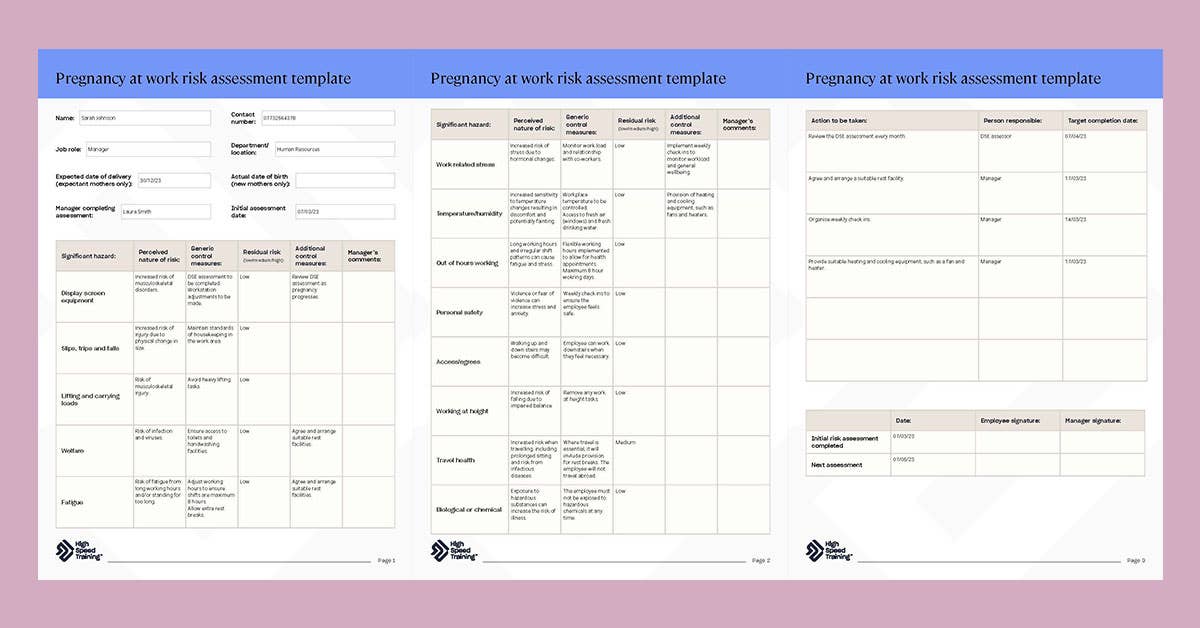
As when using any template it is important that you make the necessary changes to reflect your workplace and usual day-to-day activities. Take a look at our example pregnancy at work risk assessment, and download your free blank template to use in your workplace below:
Workplace pregnancy risk assessments help to ensure the health and safety of pregnant employees, new mothers and women who are breastfeeding. Laws and regulations place legal duties on employers to protect pregnant women and their unborn child from work-related risks. There are a multitude of risks that should be considered in the risk assessment and control measures should be implemented.
Further Resources:
- Risk Assessment for Working from Home
- DSE Workstation Assessment and Checklist
- Workplace Health & Wellbeing Quiz
- HR Guide to Health & Safety – PDF Template
- Risk Assessment Quiz
- Health and Safety Quiz
- Health & Safety Training Courses
- Menopause in the Workplace
- Menopause Awareness Training Course


Post Author